
Jump to: What is it? | What types of deeds do we offer? | Benefits | Who needs one? | How to order? | FAQs





What is a deed of trust?
A Deed of Trust (also known as a Declaration of Trust) is a legally binding document for joint property owners. It explicitly declares your percentage of ownership—known as your beneficial interest shares—ensuring your financial investments are protected.
Beyond just ownership percentages, a well-drafted deed of trust outlines your exact intentions for the property. It legally records how you will split ongoing expenses, how rental income will be divided, and the exact mechanics of what happens if the relationship breaks down or one owner wants to force a sale.
What types of trust deeds do we offer?
Our specialist solicitors have drafted a suite of standard trust deeds tailored to cover the most common property ownership circumstances and relationships.





Call or email for a quote on 0333 344 3234 / help@samconveyancing.co.uk, or Ask a Free Online Question.
What are the benefits of a deed of trust?
A deed of trust allows you to protect your interests, intentions, and financial well-being in a transparent, legally enforceable document that is executed as a deed.
-
Protect your initial deposit
Ring-fence what you specifically invested in the property so you get it back upon sale. -
Establish clear exit strategies
Agree on the exact terms for selling the property if one person refuses to do so in the future. -
Legally bind all owners
Ensure all parties are legally committed to the terms, conditions, and outgoings outlined in the deed.
-
Save thousands in legal fees
Avoid going to court to prove your beneficial interest or to force a sale under TOLATA. -
Prevent future disputes
Avoid bitter arguments over the original property ownership intentions by getting it in writing on day one. -
Streamline HMRC tax compliance
Easily submit the deed to HMRC alongside a Form 17 as required evidence for income tax efficiency.
Need a Deed of Trust for your Form 17?
If you are married or in a civil partnership and want to share rental income unequally for tax efficiency, you must submit a Form 17 to HMRC alongside a formal Declaration of Trust. We can draft an HMRC-compliant deed to ensure your unequal beneficial interests are legally documented and accepted by the tax office.
Read our step-by-step guide on how to file your Form 17.
CEO of SAM Conveyancing
Who needs a deed of trust?
You should strongly consider executing a trust deed if you fall into any of the following categories:
- Buying jointly with unequal deposits: If the initial investment and ongoing financial responsibility are going to be anything other than a straight 50/50 split.
- Gifting a deposit (Bank of Mum and Dad): If you want to protect a gifted deposit. For example, ensuring your child gets your full financial gift back before the remaining equity is split if their relationship with their co-owner breaks down.
- Moving in with a legal owner: You can legally define that your financial contributions (like paying for an extension) earn you a beneficial interest in the property. Alternatively, you can sign a Declaration of No Interest to explicitly protect your partner's sole ownership.
- Submitting Form 17 to HMRC: If you are married or in a civil partnership and need to register an unequal beneficial ownership split to ensure rental income is taxed efficiently.
- Existing owners changing shares: If you need to formally change the split of shares with an existing joint owner or assign a portion of your shares to a new beneficiary.
- Separating from your spouse: If you need to assign all your beneficial shares to your ex-partner, but must remain on the legal title deeds for mortgage purposes.
- Investing in a property: If you are investing capital into a property and want to ensure your investment is returned either as a fixed amount plus interest, or as a distinct share of the sale proceeds.
How does our fixed-fee deed service work?
Your deed will be expertly drafted to suit your specific needs, including one free revision. Once finalised, you will print, sign, and date your deed with your witnesses, before returning it to our solicitor for formal certification.
-
1
Speak to our deed team to discuss your requirements
-
2
Complete our instruction form and pay securely
-
3
Receive your first draft
-
4
Sign and execute your deed
-
5
Receive your certified copy
If you already know which deed you require, you can skip this step. If you are unsure which deed best suits your needs, whether you should include a floating formula, or if you need bespoke provisions, our specialist in-house deed team is on hand to talk you through your options free of charge. Call us on 0333 344 3234 or ask a question online.
Instruct us online instantly. You will fill in your details, upload your proof of ID and proof of address, and pay our fixed fee. Once received, our panel solicitor will begin drafting your document immediately.
Our solicitor will send you the finished draft within 1 to 2 working days(i). Most clients accept this draft as final, but you may request one free revision at this stage to correct any details.
To legally execute the document as a deed, both parties and their independent witnesses must sign and date the document in wet ink. You will then post it back to our solicitor for certification. This adds a crucial layer of protection against any future disputes over the execution date.
Our solicitor will email you a digitally certified copy, ready to be forwarded directly to your mortgage lender, conveyancing solicitor, the Land Registry, or HMRC. Your original hard-copy document will be returned to you safely by post.
Need your deed quickly? We understand you may require a deed at short notice to complete a property purchase. We can often arrange expedited drafting of documents for an additional fee. Contact us to discuss your urgent requirements.
Free initial advice on how our deeds can work for you
Arrange a free consultation with one of our experienced conveyancing executives if you are:
- Severing joint tenancy to register as tenants in common, or vice versa.
- Buying with your unmarried partner, to protect your shares in case the relationship breaks down.
- Married or civil partners let a property, and one of you is in a lower tax bracket.
- Buying with friends or family, to protect shares based on initial and ongoing contributions from each party.
- Going to invest money in unequal shares, improvements, or renovations on the property.
- Buying a property with a mortgage, where one or more borrower(s) will not be a legal proprietor.
- Unable to buy the other owner out and want to surrender your share.

Latest Deed of Trust Tips & Guides
12,172
07/03/2026
1,715
02/01/2025
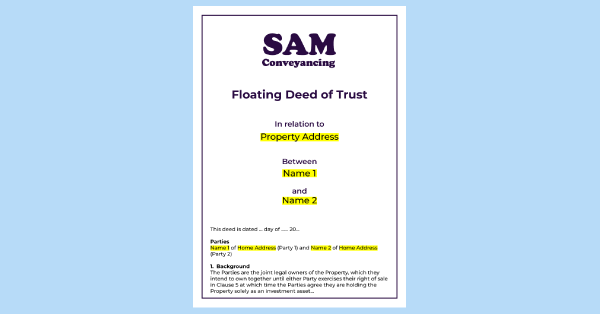
Floating Deed of Trust - A variable beneficial interest
3,617
19/02/2024

1,332
10/12/2024
1,490
26/02/2024

16,842
26/03/2025
307
19/03/2025

503
21/02/2025
18,935
26/05/2025

967
25/10/2024
2,533
29/05/2024

264
28/09/2026
6,516
23/09/2026