
Capital Gains Tax for Married Couples: No Gain, No Loss Rule

Capital Gains Tax (CGT) is payable on the profit you make when selling an asset that has increased in value, including properties that are not your main home (meaning they do not qualify for Principal Private Residence Relief). This typically includes buy-to-lets, second homes, and inherited properties.
Your CGT rate depends on your income tax band, and every individual has an annual tax-free CGT allowance. However, married couples and civil partners have a unique opportunity to minimise their Capital Gains Tax liability by transferring beneficial ownership of a property between each other, even if they aren't both legal owners of the property at HM Land Registry.
By executing a Deed of Trust, a married couple can share the beneficial interest in a tax-efficient way so that the lower-income earner holds a larger beneficial share of the property. When the property is eventually sold, they can utilise both of their individual tax-free CGT allowances and have the profit taxed at a lower overall rate.
- Transferring property between spouses or civil partners is generally exempt from Capital Gains Tax (CGT) at the point of transfer due to the "no gain, no loss" rule.
- A higher-rate tax-paying spouse can assign a larger share of the property to a spouse in a lower tax bracket to significantly reduce their combined CGT liability upon sale.
- It is imperative that you file a Form 17 with HMRC if you are both named as legal owners and want to split rental income unequally (to match your specific beneficial shares).
- If CGT is due on a residential property disposal, a separate UK Property Return must be filed by each spouse and paid within 60 days of completion.
- The CGT rate and liability are locked in at the exchange of contracts, not on completion.
- Beneficial ownership shares must be adjusted via a Deed of Trust before contracts are exchanged. You cannot adjust shares retrospectively to avoid tax.
CGT reliefs on property transferred to a spouse
When an asset is transferred between spouses or civil partners, it is legally treated as a "no gain, no loss" transaction. This means no Capital Gains Tax is payable at the time of the transfer, regardless of how much the property has increased in value since it was purchased.
This rule dictates that the receiving spouse simply inherits the original purchase cost (the base cost) of the property. This allows couples to strategically plan their tax liability before they sell, ensuring they utilise both CGT allowances.
Note: For property transfers to anyone other than a legally recognised spouse or civil partner, read our guide on Capital Gains Tax on Gifted Property.
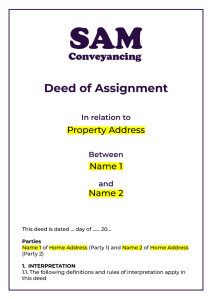
Our solicitors can draft your Deed of Assignment within 1 to 2 working days.
- Assign any amount of beneficial interest from 1% to 100% between the legal and non-legal owners.
- Change the beneficial interest at a future date for Capital Gains Tax purposes.
- For tenants in common.
- Does not assign debts or outgoings.
£299 INC VAT
What is the current rate of Capital Gains Tax?
|
Tax Band
|
Income Tax Band
|
Capital Gains Tax Rate (chargeable on profits)
|
|
Basic rate income taxpayer
|
£0 to £50,270
|
18%
|
|
Higher rate income taxpayer
|
Over £50,270
|
24%
|
Can married couples share their capital gains allowance?
Yes. Married couples and civil partners are taxed as separate individuals, meaning you each have your own annual Capital Gains Tax allowance. By transferring property ownership so that you hold it jointly as Tenants in Common, you effectively double your household's tax-free allowance when it comes time to sell.
How do you transfer your property to your spouse?
To transfer the beneficial interest of a property, you require a specialist conveyancing solicitor to draft a legally binding Deed of Trust (or Deed of Assignment) and, if you currently own the property as Joint Tenants, a Notice of Severance. Contact us online to find out how our solicitors can help you structure this quickly and compliantly.
Draft a Deed of Assignment
This legally transfers a portion of the beneficial ownership of the property to your spouse/civil partner without needing to change the legal title.
This allows you to split the capital gain percentage in any way (50-50, 99-1, etc.) to take advantage of both tax-free allowances.
File a Form 17 (optional)
While not strictly required when the property isn't jointly owned, filing a Form 17 can provide HMRC with a clear record of the ownership split with a signed, witnessed, and dated deed.
Sell the property
Remember that the CGT rate is determined at the exchange of contracts, not completion. Be careful around the government's budget announcements as rates may go up or down.
File Capital Gains Tax return
Each spouse/civil partner must file a separate return and pay the tax liability within 60 days of completion. You can file a return online on the government website.
Sever the joint tenancy and register as tenants in common
If you own the property as joint tenants (meaning you equally share any gain), you'll need to sever the joint tenancy to become tenants in common, allowing for unequal ownership shares.
Draft a Deed of Assignment
This document will outline the agreed-upon ownership percentages without changing the property's title. This allows you to split the capital gain percentage in any way (50-50, 99-1, etc.) to take advantage of both tax-free allowances.
File a Form 17
This is required if you are not splitting the ownership 50/50. It informs HMRC of the actual ownership percentages.
Sell the property
The CGT rate is determined at the exchange of contracts. Be careful around the government's budget announcements as rates may go up or down.
File Capital Gains Tax return
Each spouse/civil partner must file a separate return and pay the tax liability within 60 days of completion. You can file a return online on the government website.
Share rental income or transfer property ownership quickly and easily with a Deed of Assignment.
Get your first draft within 1-2 working days*.
Our experienced solicitors draft deeds for various purposes, from buy-to-let transfers to protecting your interest in the family home.
- Transfer rental income efficiently.
- Assign Capital Gains securely.
- Transfer full or partial ownership seamlessly.
When can you transfer a gain to your spouse or civil partner?
A transfer of beneficial ownership can happen at any time during your ownership, but if you are doing it to reduce your Capital Gains Tax exposure, it must be executed strategically before you agree to a sale.
Critical Risk: Form 17 and Exchange of Contracts
Many couples mistakenly believe they can adjust their ownership shares at the last minute right up until the day of completion. This is legally incorrect and will result in HMRC taxing the original owners.
- The Date of Disposal: For Capital Gains Tax purposes, the legal date of disposal is the day unconditional contracts are exchanged, not the date of completion. Your Deed of Trust must be executed before exchange.
- Form 17 Confusion: Form 17 is an HMRC declaration used exclusively to split rental income for Income Tax purposes. Filing a Form 17 has no retroactive bearing on a Capital Gains Tax disposal that has already occurred.
How can married couples or civil partners minimise Capital Gains Tax?
You cannot entirely avoid CGT on a taxable property profit unless the gain falls completely within your available annual tax-free allowances. However, you can significantly minimise the liability by strategically sharing the gain based on your respective income brackets.
Because Capital Gains Tax rates are tied directly to your standard income tax band, a basic-rate taxpayer pays a significantly lower percentage on property gains than a higher-rate taxpayer.
The income tax bands on work and rental income are as follows:
| Tax Band | Taxable Income (Employment and Property) | Tax Rate |
|---|---|---|
| Tax Band Tax free allowance | Taxable Income (Employment and Property) £12,570 | Tax Rate 0% |
| Tax Band Higher rate | Taxable Income (Employment and Property) £50,271 to £150,000 | Tax Rate 40% |
| Tax Band Additional rate | Taxable Income (Employment and Property) over £150,000 | Tax Rate 45% |
NOTE: Work and rental income are not separate. You combine all your earnings (work and rental) and then you look into your bracket.
Source: HMRC - Income Tax Rates
If one spouse is in a lower income tax band, legally transferring a larger portion of the beneficial ownership (e.g., a 90%/10% split) to them prior to the sale allows the majority of the profit to be taxed at the lower CGT rate, protecting thousands of pounds.
What if both the husband and wife are higher-rate taxpayers?
If both spouses or civil partners already fall into the higher or additional-rate income brackets, there is no percentage rate advantage to transferring ownership, as both will pay the higher CGT rate regardless. However, transferring a share to ensure the property is jointly owned is still highly beneficial, as it allows the couple to combine and utilise both of their individual annual tax-free CGT allowances.

Andrew Boast FMAAT is a qualified accountant, conveyancing specialist and author with over 25 years of experience in the UK property sector. Since beginning his career in 2000 within established SRA and CLC-regulated conveyancing solicitor firms, Andrew has overseen the legal journeys of more than 75,000 clients.
He is the self-published author of the first-time buyer guide: How to Buy a House Without Killing Anyone, and a frequent contributor to mainstream UK media on legislative updates, property law, first-time buyer guides, conveyancing best practices, and stamp duty changes. Andrew specialises in resolving complex title issues, property conflict disputes, and property tax options, streamlining the enquiry process to reduce transaction times and maintaining a client-friendly focus.

Amanda Ambler is a highly accomplished conveyancing specialist with over 15 years of dedicated experience across residential property law, legal compliance, and practice management. Having held senior roles, including Head of Legal Practice and Head of Conveyancing at established UK law firms, Amanda possesses a profound, hands-on understanding of the technical intricacies of the property market.
As the designated Legal Content Reviewer for SAM Conveyancing, Amanda ensures that every guide, legal update, and resource published meets the absolute highest standards of accuracy, regulatory compliance, and factual integrity. Her rigorous review process guarantees that complex property legislation and industry processes are communicated clearly, transparently, and safely for home buyers and sellers alike.