
Capital Gains Tax on Gifted Property: Connected Persons Rules

Capital Gains Tax (CGT) on gifted property is payable depending on the relationship between the owner and the recipient, and whether the property has ever not been your main home. If you are deemed a 'connected person' to the recipient, HMRC calculates Capital Gains Tax based on the property's full open market value, regardless of whether any money actually changes hands.
HMRC closely examines the relationship between the transferor and transferee to determine how to treat property gifts, especially if the property is being transferred under market value, known as a Concessionary Purchase.
Even a remortgage can trigger CGT considerations if it involves a transfer of beneficial interest alongside a change in legal ownership.
In this guide, we explain how HMRC defines connected persons, how open market valuations dictate your tax bill, and how Private Residence Relief (PRR) can significantly reduce or eliminate your Capital Gains Tax liability.
- Full Market Value Rule: If you gift property to a 'connected person' (such as a child), HMRC ignores the actual price paid and calculates CGT based on the full open market value.
- Principal Private Residence Relief: You pay zero Capital Gains Tax if the property has been your only or main home for the entire period of ownership.
- 60-Day Deadline: If CGT is due, you must report the disposal and pay the tax to HMRC online within 60 days of legal completion—not on your annual Self Assessment.
- Clogged Losses Trap: A capital loss on a gift to a connected person cannot be offset against general capital gains; it can only offset future gains made with that exact same relative.
- Spousal Exemption: Transfers between legally recognised spouses or civil partners are completely exempt from CGT under "no gain, no loss" rules.
You do not need to pay CGT if:
- You lived in the home as your main residence for the entire time you owned it (qualifying fully for Private Residence Relief (PRR)).
- You transfer the property to your spouse or civil partner (these transfers are made on a tax-free "no gain, no loss" basis).
- You transfer the property into certain types of trust (such as a discretionary trust), where you can jointly claim "Hold-Over Relief" to defer the CGT. Note: This does not apply to bare trusts, which are treated as direct gifts.
What capital Gains Tax is payable on a gift of property to a child?
There is no Capital Gains Tax on your principal place of residence (the main home where you live) due to Private Residence Relief. CGT typically only applies to additional properties, such as a buy-to-let investment or a holiday home. It will also apply if you once lived in the property as your main residence and then moved to a new main residence.
Get a Fixed Fee quote today for a gifted property transfer between family. We can help whether it is a zero-consideration transfer or a discounted concessionary purchase.
- All-Inclusive Quote.
- Fast Completions.
- Working with specialist conveyancing solicitors.

What is the market value rule for CGT?
When you sell a property on the open market, the capital gain is normally calculated using the actual amount you dispose of the asset for. This is because the sale is an arm's-length transaction in which you are expected to maximise the proceeds.
However, if you are selling or gifting the property to someone you are connected to (like your child), HMRC rules strictly ignore the actual price paid. Instead, the disposal is taxed based on the property's full open market value.
The specific HMRC rules governing the gift of property to children and the use of market value are detailed in their manual under CG14530.
How do you know the current market value of your property?
While a local estate agent can give you a rough marketing appraisal, HMRC requires a robust, evidence-based figure. The safest and most accurate way to establish the true open market value when gifting a property is to instruct a RICS Registered Valuer to carry out a formal Red Book Valuation.
It can be tempting to artificially deflate the market value to reduce your Capital Gains Tax liability on the disposal, but this is a highly dangerous strategy. HMRC actively monitors family property transfers and frequently instructs its own District Valuer Services (DVS) to challenge suspicious or self-assessed figures.
The Penalty Risk: If HMRC investigates and proves the property was worth more than you declared, you will be legally required to pay the tax shortfall immediately, plus daily interest. Furthermore, if HMRC deems the undervaluation to be careless or deliberate, they can issue severe financial penalties of up to 100% of the unpaid tax.
Case in Point (Palliser v HMRC, 2018): HMRC will aggressively challenge valuations they believe are too low. In this landmark tribunal, a £1.4 million property valuation was successfully contested because the surveyor failed to include the property's development potential (known as "hope value"). The court ruled the true value was £1.6 million. If your gifted property has obvious room for extension or development, HMRC expects that potential to be reflected in your valuation.
Chartered Surveyor, RICS Registered Valuer
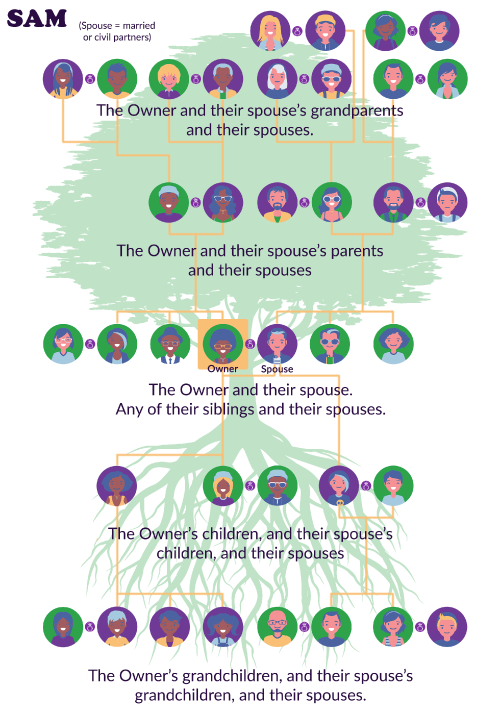
Connected person CGT - a family tree
When a property is gifted to a connected person, the donor (the person giving the property) will be liable for Capital Gains Tax on the full capital gain, based strictly on the current market value—regardless of whether any money was actually paid for it.
Critical Risk: Misunderstanding Clogged Losses
A major tax trap occurs if you gift a property to a connected person and make a capital loss. Under Section 18(3) of the TCGA 1992, HMRC legally restricts this as a "clogged loss".
You cannot use a clogged loss to offset your general capital gains (such as profits from selling shares or a different buy-to-let). A clogged loss is ring-fenced and can only be used to offset future capital gains made on other transfers to the exact same connected person. If you never transfer any other profitable asset to that same person, the loss will be trapped forever.
Example of gifting to a connected person:
If you gift a property currently worth £500,000 to your child (a connected person), and your original purchase price was £200,000, you will be liable for CGT on the £300,000 gain. Even though you haven't actually sold the property for cash, the gift to your child is treated by HMRC as a sale at the market value of £500,000.
Your child will then own the property with a new base cost of £500,000. If they later sell the property on the open market for more than £500,000, they will have to pay CGT on the difference.
Below is a family tree showing exactly who HMRC considers to be connected to the owner for CGT purposes.
Example of a Capital Gains Tax calculation when gifting property to children
This is an example of a straightforward Capital Gains Tax calculation for a gifted property. Because the property was transferred to a family member (a connected person) at an undervalue, the calculation is strictly based on the property's full open-market value, ignoring any discounted price actually paid.
|
|
£
|
|
Proceeds from the sale of the property at Market Value |
i.e £500,000
|
|
Take Away |
|
|
Costs of disposal - eg. estate agent's fee, solicitor's fee , extension/improvement costs |
i.e £25,750
|
|
Equals = net proceeds of the sale |
i.e £474,250
|
|
Take Away |
|
|
Original purchase price of property |
i.e £200,000
|
|
Costs of original purchase - eg. stamp duty, Land Registry fees, solicitor's fee |
i.e £1,500
|
|
Gain (or loss) |
i.e £272,750
|
|
Capital Gains Tax allowance - the annual exemption |
(2024-25) £3,000
|
|
Amount subject to Capital Gains Tax |
i.e £269,750
|
You should speak to a tax advisor for capital gains tax advice.
What is the rate for Capital Gains Tax on gifted property?
|
Tax Band
|
Income Tax Band
|
Capital Gains Tax Rate (chargeable on profits)
|
|
Basic rate income taxpayer
|
£0 to £50,270
|
18%
|
|
Higher rate income taxpayer
|
Over £50,270
|
24%
|
Critical Risk: The Capital Gains Tax 60-Day Trap
This is the single biggest operational trap when gifting residential property. Under HMRC rules, any disposal resulting in a Capital Gains Tax liability must be reported and paid online via the official Capital Gains Tax on UK property service within 60 days of completion.
Many sellers mistakenly assume they can simply wait and declare the gift on their end-of-year Self Assessment tax return. You cannot. Missing this strict 60-day window triggers an immediate statutory late-filing penalty of £100, followed by further fixed penalties and compounding daily interest charges if left unpaid.
Frequently Asked Questions

Andrew Boast FMAAT is a qualified accountant, conveyancing specialist and author with over 25 years of experience in the UK property sector. Since beginning his career in 2000 within established SRA and CLC-regulated conveyancing solicitor firms, Andrew has overseen the legal journeys of more than 75,000 clients.
He is the self-published author of the first-time buyer guide: How to Buy a House Without Killing Anyone, and a frequent contributor to mainstream UK media on legislative updates, property law, first-time buyer guides, conveyancing best practices, and stamp duty changes. Andrew specialises in resolving complex title issues, property conflict disputes, and property tax options, streamlining the enquiry process to reduce transaction times and maintaining a client-friendly focus.

Amanda Ambler is a highly accomplished conveyancing specialist with over 15 years of dedicated experience across residential property law, legal compliance, and practice management. Having held senior roles, including Head of Legal Practice and Head of Conveyancing at established UK law firms, Amanda possesses a profound, hands-on understanding of the technical intricacies of the property market.
As the designated Legal Content Reviewer for SAM Conveyancing, Amanda ensures that every guide, legal update, and resource published meets the absolute highest standards of accuracy, regulatory compliance, and factual integrity. Her rigorous review process guarantees that complex property legislation and industry processes are communicated clearly, transparently, and safely for home buyers and sellers alike.