Office Copy Entries Explained

Office copy entries are certified copies of the land or charge certificate obtained from the Land Registry, confirming ownership of a property.
An office copy entry is officially known as an Official Copy of Register of Title – and also a title register – and, in effect, is the certified, modern equivalent of the old Title Deeds, physical documents which were used in previous times to prove property ownership and show the ownership chain. In effect, it is a snapshot of the details of the most recent title deeds for a particular property, which a vendor's solicitor normally orders and passes on to the buyer's solicitor for perusal. It is normally always accompanied by the Land Registry Title Plan, which shows the general position of the property.
Nowadays, the only time the Land Registry has physical original Title Deeds in its possession is when a property is being registered for the first time, in which case a solicitor registering the property must send them in to be scanned, after which they are returned to the solicitor.
Why would you get an office copy entry?
You obtain an office copy entry as an owner of a property to prove that ownership if you intend to sell it. If the property is registered, anyone can buy an office copy entry. The buyer can ascertain who owns the property (the freeholder), whether it has been leased to one or more leaseholders, and whether there are any charges on the property, such as a mortgage from a lender that hasn’t yet been redeemed.
There may, for example, be restrictions which might affect registering a new mortgage. There may also be covenants. You can also learn about the property's history of ownership and other important matters, such as any changes to its legal boundaries.
What do office copy entries show?
An office copy entry must have 'Official Copy of the Register of Entries' at the head of the first page. If it is not or is headed 'Register View', then it is not an official copy and is not admissible as evidence of the contents of the register.
There are 4 sections:
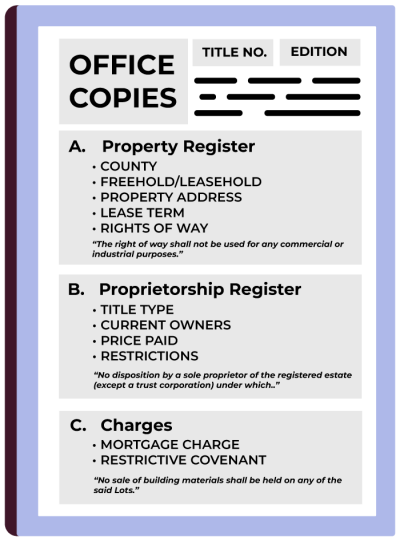
The Header
The header of the office copy includes:
- The title number. The Land Registry gives a unique title number for every title in England and Wales.
- Edition Date. This date indicates when the title was last updated. This may have been, for example, when the property was last sold, when a mortgage was registered or when a restriction or notice was added. Any change creates a new edition.
- Date and time of official copy. This is when the official copy was produced, and the Land Registry guarantees that the copy’s contents accurately reflect the information held at that date and time. The office copy is technically out of date the moment it is produced.
- Land Registry office that deals with the title. This sets down the details of which office at the Land Registry is responsible for registration applications for this property.
Section A - Property Register
This describes the land in the title and any rights which benefit it.
- County : District. You can find out the county the property is in and which local authority it comes under.
- Property Description. This tells you whether the property is freehold or leasehold, details its address, and shows that the land’s boundaries are edged on the title plan. The date at the start of the entry is the date of first registration with the Land Registry.
- Lease terms. (if leasehold) The original lease term is stated.
- Rights. Rights-of-way, easements, light, and utilities will be listed here.
Section B - Proprietorship Register
This part tells you the class of title and who the current owner is, and provides information about anything that affects the right of disposal.
- Title Class. This can be one of the following four: Absolute, Possessory, Qualified, or Good.
- Proprietor names. Entry 1 is the name/s and address/es of the legal owners the Land Registry holds for contact purposes. The date in brackets is the date when these owners were registered as such.
- Price Paid. Entry 2 is the price paid when the current legal owners bought/transferred the property, and the date it was bought. If the property has not been sold since April 2000, there will be no entry here, as the Land Registry’s information only extends that far.
- Personal Covenants. This section lists any personal covenants given by the former owner to the current owner, such as an indemnity covenant.
- Restrictions. Entries here prevent dispositions from being registered without an additional action, which is normally obtaining a certificate or deed of consent from a third party. Commonly, restrictions are instituted by mortgage lenders; they might, for example, require a lender’s consent before any new mortgage is permitted on the property or before the property can change hands.
Section C - Charges Register
This section sets out any existing mortgages, other financial charges, notices, and restrictive covenants (including, for example, easement rights) affecting the property. They appear in the order they were originally registered, with earlier entries having priority over later ones.
Why can’t I get an office copy entry?
If your property isn’t on the register, you must apply for first registration and send in the original title deeds. You should ask the solicitor who acted for you when you bought the property or the relevant mortgage company if you bought using a mortgage.
If you cannot get hold of your Title Deeds, you must supply a statutory declaration or statement of truth and prove your ID. In the worst-case scenario, you may only be able to obtain a possessory title, although you can apply to convert a possessory title to an absolute title after 15 years.
For official Government guidance about finding out information about properties, click on Get Information About Properties
When do I need a copy of the title?
A solicitor must obtain an up-to-date copy of your title for any transaction that changes the title, including:
- Remortgage
- Transfer of equity
- Sale
The risks of using outdated office copies
An office copy entry is a snapshot in time. According to HM Land Registry guidelines, an official copy is technically out of date the exact moment it is downloaded. Because the central Land Register is a live, continuously updated public record, relying on an outdated document during a property transaction presents several significant hazards for both buyers and sellers:
- Critical Risk: Inheriting Undisclosed Financial Charges or Bankruptcy Notices. If an outdated office copy is used, neither the buyer nor their solicitor will see any new legal charges, second mortgages, or bankruptcy notices registered against the property after the document's extraction date. Proceeding without this knowledge could mean a buyer inadvertently takes on a property burdened with third-party debt. In cases of a newly registered bankruptcy notice or restriction, the buyer may find that the seller is legally barred from transferring title entirely, resulting in a failed sale and lost funds.
- High Risk: Purchasing Land with Altered Boundaries. Using an outdated title register and accompanying title plan means you might miss recent transfers of part of the land. If the current owner has legally sold off a portion of the garden, granted a new right of way, or altered the boundaries since the copy was produced, you risk buying a property with fundamentally incorrect boundary lines. This routinely leads to severe legal disputes with neighbours over land ownership.
- Moderate Risk: Transaction Delays and Additional Enquiries. Supplying an old copy of the title to a buyer's conveyancer will immediately stall the transaction. A diligent solicitor cannot confidently raise standard pre-contract enquiries or finalise the legal paperwork until an up-to-date, certified official copy is provided. They must be able to verify the current ownership and ensure no new third-party restrictions exist before proceeding.
How Conveyancers Mitigate This Risk
To ensure facts are accurate up to the point of completion, standard UK conveyancing protocols require the buyer's solicitor to perform a pre-completion search. This is known as an Official Search of Whole with Priority (OS1) or Official Search of Part (OS2).
This search checks for any alterations to the register since the date of the office copy entry and provides a priority period of 30 working days. During this 30-day window, the register is effectively frozen, ensuring no new charges or restrictions can be registered against the property before the buyer’s purchase is officially finalised.
CEO of SAM Conveyancing
Frequently Asked Questions About Office Copy Entries

Andrew Boast FMAAT is a qualified accountant, conveyancing specialist and author with over 25 years of experience in the UK property sector. Since beginning his career in 2000 within established SRA and CLC-regulated conveyancing solicitor firms, Andrew has overseen the legal journeys of more than 75,000 clients.
He is the self-published author of the first-time buyer guide: How to Buy a House Without Killing Anyone, and a frequent contributor to mainstream UK media on legislative updates, property law, first-time buyer guides, conveyancing best practices, and stamp duty changes. Andrew specialises in resolving complex title issues, property conflict disputes, and property tax options, streamlining the enquiry process to reduce transaction times and maintaining a client-friendly focus.

Amanda Ambler is a highly accomplished conveyancing specialist with over 15 years of dedicated experience across residential property law, legal compliance, and practice management. Having held senior roles, including Head of Legal Practice and Head of Conveyancing at established UK law firms, Amanda possesses a profound, hands-on understanding of the technical intricacies of the property market.
As the designated Legal Content Reviewer for SAM Conveyancing, Amanda ensures that every guide, legal update, and resource published meets the absolute highest standards of accuracy, regulatory compliance, and factual integrity. Her rigorous review process guarantees that complex property legislation and industry processes are communicated clearly, transparently, and safely for home buyers and sellers alike.



How Do I Change My Name on the Land Registry?