Can You Have Unequal Shares in a Property?

Buying a home with a partner, family member, or friend is an exciting milestone, but what happens when one of you is putting down a significantly larger deposit or paying more toward the mortgage? Fortunately, can you have unequal shares in a property? Yes, you absolutely can, and if your financial contributions aren't identical, you should.
Failing to formalise these differences can leave your hard-earned capital entirely unprotected if your circumstances change or the relationship breaks down. By registering your ownership correctly as Tenants in Common and securing your investment with a Deed of Trust, you can ensure that everyone's financial stakes are legally locked in from day one.
Understanding joint ownership: Joint Tenants vs Tenants in Common
When purchasing a property with a partner, family member, or friend in England and Wales, you must select how your legal ownership will be registered. This choice determines whether you can divide the equity unequally. There are two primary frameworks for joint ownership:
Joint Tenants:
Co-owners own the property 100% together. There are no distinct, individual shares, and ownership is always split equally. If one owner passes away, their share automatically transfers to the surviving co-owner through the right of survivorship, regardless of what is written in a will. This is the traditional path for married couples.Tenants in Common:
Co-owners hold distinct, separate shares in the property. Because these shares are clearly demarcated, they do not have to be equal. You can split ownership 60/40, 70/30, or in direct proportion to your financial contributions. Crucially, there is no right of survivorship; your share can be left to anyone you choose in your will.
If your goal is to own a property in unequal shares to reflect different financial inputs, you must register the property as Tenants in Common. If you have already purchased the property, and are Joint Tenants, then you can change the ownership to tenants in common.
Buy as
Joint tenants, or
Tenants in Common
By Andrew Boast, CEO of SAM Conveyancing
How to split property shares unequally
You must first register your property at the Land Registry as Tenants in common. You do this during the conveyancing process using the TR1 Form. If you already own the property, then you can sever the joint tenancy and register as tenants in common.
How do you tell if you're tenants in common?
You can check if you are tenants in common by downloading your title plan from the Land Registry and looking for the requisite restriction in Section B of your title. If you can see the Form A Restriction, then you are tenants in common. A Form A restriction looks like this:
No disposition by a sole proprietor of the registered estate (except a trust corporation) under which capital money arises is to be registered unless authorised by an order of the court.
Source: Land Registry: Form A restriction
How do you document tenants in common in unequal shares?
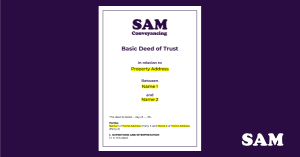
Once you're tenants in common, you don't automatically have your shares protected or confirmed as unequal. To formalise your precise ownership percentages, you require a Deed of Trust (frequently referred to as a Declaration of Trust).
A Deed of Trust is a legally binding document drafted by a solicitor during the conveyancing process. It serves as a clear financial roadmap, outlining exactly who owns what and protecting individual interests regarding:
- The Initial Deposit: Ring-fencing unequal lump-sum contributions at the outset (e.g., if one party provides £40,000 and the other provides £10,000).
- Mortgage Repayments: Specifying whether monthly mortgage payments are split 50/50 or in an unequal ratio that matches your ownership split.
- Maintenance and Outgoings: Clarifying who is responsible for structural repairs, insurance, and utility bills.
- The Exit Strategy: Outlining what happens if one person wishes to sell, move out, or buy the other party out.
We offer a variety of deeds depending on the type of relationship you have:
Relationship | Purpose | Type of deed |
Married Couples | Owning property in unequal shares for HMRC Form 17. | A Deed of Assignment costing £299 INC VAT or a Deed of Trust costing £304 INC VAT. Both are the evidence HMRC require alongside the Form 17. |
Unmarried Couples | Protecting property deposit for unmarried couples. | A Deed of Trust should be used that has a clear exit strategy in the event of a break-up. You might also choose a floating deed that allows your unequal share to rise and fall with your investment. The cost of a floating deed is £399 INC VAT. |
Joint Mortgages with Unequal Shares: Case Study Example
To understand how a Deed of Trust protects your capital, consider a practical scenario. Imagine three friends—Jane, Michael, and Michelle—purchasing a home together for £250,000 using an unequal breakdown of initial capital to cover the deposit and buying costs. The total initial capital required for their 10% deposit, Stamp Duty, Land Registry fees, and legal expenses comes to £28,164. They contribute unequal amounts, which establishes their exact beneficial interest split in the Deed of Trust:
Here's an example of owning a property as tenants in common (unequal shares)
Example of an unequal deposit
Invested | Share | |
Jane | £10,000 | 35.5% |
Michael | £5,000 | 17.7% |
Michelle | £13,164 | 46.8% |
Is buying unequal shares in a property with someone else a good idea?

Andrew Boast FMAAT is a qualified accountant, conveyancing specialist and author with over 25 years of experience in the UK property sector. Since beginning his career in 2000 within established SRA and CLC-regulated conveyancing solicitor firms, Andrew has overseen the legal journeys of more than 75,000 clients.
He is the self-published author of the first-time buyer guide: How to Buy a House Without Killing Anyone, and a frequent contributor to mainstream UK media on legislative updates, property law, first-time buyer guides, conveyancing best practices, and stamp duty changes. Andrew specialises in resolving complex title issues, property conflict disputes, and property tax options, streamlining the enquiry process to reduce transaction times and maintaining a client-friendly focus.

Amanda Ambler is a highly accomplished conveyancing specialist with over 15 years of dedicated experience across residential property law, legal compliance, and practice management. Having held senior roles, including Head of Legal Practice and Head of Conveyancing at established UK law firms, Amanda possesses a profound, hands-on understanding of the technical intricacies of the property market.
As the designated Legal Content Reviewer for SAM Conveyancing, Amanda ensures that every guide, legal update, and resource published meets the absolute highest standards of accuracy, regulatory compliance, and factual integrity. Her rigorous review process guarantees that complex property legislation and industry processes are communicated clearly, transparently, and safely for home buyers and sellers alike.