How to Negotiate a House Price: Making an Offer & After Survey

Knowing how to negotiate a house price in England and Wales can save you thousands of pounds, whether you are putting in an initial offer or renegotiating after a property survey. Offer too little without evidence, and you risk alienating the seller; offer too much, and you could overpay or inherit thousands of pounds in unexpected repair bills.
With UK estate agents reporting that only 9% of properties currently achieve their full asking price, buyers have strong room to negotiate a house price, but knowing how and when to do it is vital. Sellers won't automatically agree just because you asked, and the selling agent will push back on any cheeky offers that aren't backed up by facts.
In this guide, we explain the average house price reductions achieved by UK buyers, step-by-step tactics for negotiating your initial offer, how to renegotiate after a survey or mortgage down-valuation using official RICS rules, how to use our House Price Negotiation Letter Template, and what to do if the seller rejects your offer. You might also like to read our guides on when you should order your survey and how long it takes from survey to completion.
- Most homes sell below asking price in 2026: Propertymark reports that 86% of estate agents are seeing homes sell below asking price, while Rightmove data shows 34% of listed homes (1 in 3) have their asking price reduced on the portal by an average of nearly 7% (£21,000).
- Target a 5% to 10% initial discount: Unless a property is priced below market value to attract a bidding war, most successful negotiations fall between up to 5% off (20% of buyers) and 5% to 10% off (14% of buyers).
- Sell your "proceedability": Sellers frequently accept a lower offer from a chain-free buyer, first-time buyer, or cash buyer who already has a Mortgage in Principle and a conveyancing solicitor instructed over a higher offer from an unorganised buyer in a slow chain.
- Negotiate twice if needed: Even if you agree a price upfront, all offers in England and Wales are subject to contract and survey. If your RICS survey uncovers serious Condition Rating 3 defects, RICS advises getting at least two written contractor quotes to negotiate a price reduction prior to exchange.
- Watch your mortgage timeline: If you agree a price reduction after your mortgage offer is issued, you must notify your lender so they can reissue the revised mortgage offer, which takes 3 to 7 working days.
- What is the average reduction negotiated off a house asking price in 2026?
- How to negotiate a house price when making an initial offer
- Negotiate a win-win by understanding the seller's priorities
- How to renegotiate a house price after a RICS survey or down-valuation
- What to do if the seller rejects your offer
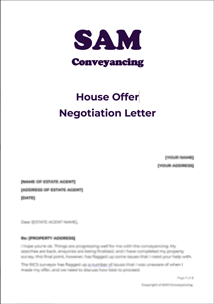
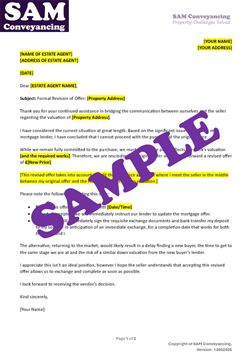
- House price negotiation letter template (£4.99)
- FAQs
What is the average reduction negotiated off a house asking price in 2026?
With a 10-year high in the number of homes for sale and stretched mortgage affordability in 2026, buyers hold strong negotiating leverage, particularly in London and the South of England. Different property bodies track price reductions at two stages: cuts made to the advertised asking price on portals like Rightmove, and discounts negotiated off the asking price when agreeing a sale:
- Rightmove (Advertised Asking Price Cuts): Rightmove's Autumn 2026 House Price Index shows that 34% of homes on the market (1 in 3 nationally, and 38% in London) have had their advertised asking price reduced. Where sellers cut their asking price on Rightmove, the average reduction is almost 7% (around £21,000), and homes needing a price cut take an average of 119 days to find a buyer compared to just 39 days for well-priced homes.
- Propertymark (Sales Agreed Below Asking Price): According to Propertymark's October 2026 Housing Insight Report, 86% of estate agents report that properties are selling below their asking price, with just 9% achieving the full asking price.
- Zoopla (Average Discount Achieved): Zoopla's 2026 House Price Index found that 52.8% of sellers who sold had to lower their asking price to secure a buyer, with the typical UK home selling for 3.5% (£18,800) below its asking price.
Looking across a wider multi-year sample of UK homeowners, consumer research by Opinium for the HomeOwners Alliance shows how buyers negotiated their purchase price:
Negotiation Outcome vs Asking Price | Percentage of UK Buyers |
|---|---|
| Paid below asking price (All successful negotiators) | 39% (35% of first-time buyers vs 42% of home movers) |
| Negotiated up to 5% off asking price | 20% |
| Negotiated 5% to 10% off asking price | 14% |
| Negotiated more than 10% off asking price | 6% |
| Paid full asking price | 39% |
| Paid above asking price (e.g. bidding wars / sealed bids) | 10% |
| Did not negotiate (e.g. new-build fixed price) | 12% |
Sources: Rightmove House Price Index (October/November 2026), Propertymark Housing Insight Report (October 2026), Zoopla House Price Index (2026), and HomeOwners Alliance / Opinium Survey.
How to negotiate a house price when making an initial offer
If you are making an offer below the asking price, you must be prepared to justify your figure with local market evidence and be ready to compromise if your opening bid is rejected. Follow these five steps to negotiate your initial offer effectively:
1. Research completed Land Registry sold prices (not asking prices)
Never judge what a property is worth solely by the asking prices of other homes currently listed on Rightmove or Zoopla. Asking prices only show what a seller hopes to achieve, and properties marked Sold Subject to Contract (SSTC) at £250,000 may have actually had an offer accepted at £230,000.
Instead, check completed HM Land Registry sold prices for homes on the same street with the same floor area, number of bedrooms, and parking over the last 6 to 12 months. Stay hyper-local: crossing a main road or school catchment boundary can add or subtract tens of thousands of pounds.
2. Check how long the property has been on the market
In 2026, a well-priced UK home takes an average of 44 days to find a buyer, while overpriced properties that require an asking price reduction take 2.4 times longer to sell. If a property has been on the market for 8 to 12 weeks, or has already had a price reduction, your negotiating position is much stronger than that of a home listed 48 hours ago with multiple viewings booked.
3. Leverage your buyer status to beat higher bidders
Price is only half of an offer; certainty and speed make up the rest. When submitting a lower offer to the estate agent, highlight every advantage that makes you a low-risk buyer:
- Chain-free status: First-time buyers, cash buyers, and buyers who have already sold their existing home represent far less risk of a chain collapse.
- Finance ready: Confirm that your deposit funds are in place and attach your Mortgage Agreement in Principle (AIP).
- Conveyancing solicitor already instructed: Telling the estate agent that you have already instructed your conveyancing solicitor and completed your ID checks proves you can issue the Memorandum of Sale on Day 1 without delay.
4. Decide how much lower than the asking price to offer
Most successful initial negotiations land between 5% and 10% below the asking price. Here is how to pitch your bid without alienating the seller:
- Don't go in too low without evidence: Offering more than 10% below the asking price with no justification rarely starts negotiations on the right foot, unless the property is visibly run-down or severely overpriced compared to recent street sales.
- Explain the maths behind your offer: If similar three-bedroom semi-detached houses on the road sold for £285,000 and the seller is asking £300,000 for one needing a new kitchen, explain that gap politely to the agent so your figure feels fair and objective.
- Consider offering the asking price subject to survey: If competition for the property is fierce, offering closer to the asking price with a caveat that it is subject to survey means you can win the bid, while preserving your right to renegotiate later if your RICS survey or mortgage valuation uncovers issues.
5. Put your offer in writing "subject to contract and survey"
Even if you make your offer over the phone to gauge the estate agent's reaction, always follow up immediately by email. State your exact offer figure, your buying position (such as chain-free first-time buyer), your solicitor's details, and confirm that your offer is subject to contract, subject to survey, and subject to the property being taken off the market immediately with all further viewings cancelled.
Expert Tip: How the estate agent sets the asking price
Remember that the estate agent is contracted by the seller to achieve the highest possible price, and agents sometimes pitch high valuations simply to win the seller's instruction over rival agencies. When setting an asking price, an agent considers current competing listings, recent sales prices, buyer demand on their books, and local market fluctuations, whereas online estate agents often let sellers set whatever asking price they want.
Because neither the seller nor the estate agent is impartial, never assume the asking price equals the property's true market value. Do your own research and only ever offer what you can comfortably afford.
CEO of SAM Conveyancing
Negotiate a win-win by understanding the seller's priorities
In any successful property negotiation, both parties need to feel they have achieved their core goal. For you, the win is buying the property at a fair price that reflects its true condition. Ask the estate agent why the vendor is moving so you can tailor your offer around the seller's priorities:
- Financial constraints on their onward purchase: A seller moving up the housing ladder may have budgeted their onward purchase tightly around the estate agent's valuation and genuinely cannot afford a steep price cut, whereas an executor selling a probate property or a landlord exiting a rental may prioritise a fast, guaranteed completion over the last £5,000.
- Accommodating their preferred completion date: If you can offer flexibility, such as completing quickly for a seller relocating for work, or giving an onward-chain seller extra time to find their next home, that convenience can be worth thousands of pounds to them.
- Appealing to the seller's connection to the home: Long-term homeowners and downsizers often prefer selling a family home to a reliable residential buyer who will look after it rather than to a developer or buy-to-let investor offering slightly more.
How to renegotiate a house price after a RICS survey or down-valuation
Renegotiating the agreed purchase price after your offer has been accepted is common in England and Wales, because property offers are not legally binding until contracts are exchanged. Post-offer price reductions usually happen for one of two reasons:
- Your independent RICS Level 2 or Level 3 Home Survey has uncovered unexpected Condition Rating 3 defects (such as a failing roof, damp and timber decay, structural movement, or unsafe electrics); or
- Your mortgage lender's valuer has down-valued the property below the agreed purchase price.
Sellers and estate agents will rarely agree to a price cut based on vague complaints or cosmetic wear and tear. To renegotiate successfully before exchange of contracts, the Royal Institution of Chartered Surveyors (RICS) recommends following a strict four-step evidence process as soon as you receive your survey report:
1. Carry out any RICS "further investigations" first
If your surveyor is concerned about a concealed part of the building, could only see part of a defect, or spots an issue requiring a specialist trade test, your survey report will recommend further investigation to discover the true extent of the problem before you make a legal commitment to buy.
Under RICS reporting standards, whenever a further investigation is recommended, your report will state:
- What and why: A description of the affected element of the building and why a deeper investigation is required.
- When: Confirmation that the investigation must be carried out before you exchange contracts.
- Who: A broad indication of the appropriately qualified specialist to instruct (for example, a PCA-approved damp and timber surveyor, a structural engineer, a CCTV drainage specialist, or a Gas Safe or NICEIC/NAPIT electrical contractor).
Because investigating hidden defects properly may require disturbing parts of the property, such as lifting fixed floor coverings, opening panelling, or drilling inspection holes, you must discuss this with the seller via the estate agent first to obtain permission.
2. Obtain at least two written quotations from insured contractors
Before approaching the seller for a price reduction, RICS advises getting reports and at least two written quotations from experienced, properly insured contractors for all urgent repairs and further investigations identified by your surveyor. If you ordered a RICS Level 3 Building Survey that included estimated repair costs, keep a note of the contractors' quotes so you can check they are in line with your surveyor's estimates.
To make sure your repair quotes stand up to scrutiny from the estate agent and seller, RICS recommends that you:
- Ask for past client references: Request references from homeowners the contractor has recently completed similar repair work for.
- Provide an identical written brief: Describe in writing exactly what work you want them to quote for, using the defect descriptions in your RICS report so both contractors quote like-for-like.
- Insist on written quotations: Get every quotation in writing on headed paper; verbal estimates carry no weight in price negotiations.
- Use regulated specialists: Where work involves gas, electrics, or plumbing, ensure the contractor belongs to a government-approved scheme (such as the Gas Safe Register or one of the five government-approved electrical Competent Person Schemes such as NICEIC or NAPIT).
Once you have your written quotes, you can ask the seller either to reduce the purchase price to reflect the unexpected repair costs, or to have the remedial work completed and signed off prior to exchange. If the seller refuses to budge, read our guide on what to do when a vendor refuses to lower the price after a survey.





3. Check Building Regulations and planning permission with your solicitor
Some remedial works, such as consumer unit replacement, boiler installation, roof replacement, or structural support, require Building Regulations approval or local authority planning permission. Send your survey extracts and contractor quotes to your conveyancing solicitor so they can raise formal legal enquiries and check whether previous alterations on the property already have valid completion certificates.
4. Renegotiating after a mortgage lender down-valuation (and telling your lender)
If your mortgage lender's valuation comes back lower than your agreed offer price, you must either negotiate the price down to the valuation figure, challenge the valuation with recent comparable sold evidence, or pay the cash shortfall yourself on top of your deposit. Buying above a lender's valuation without strong justification means starting out in technical negative equity from day one.
Important mortgage rule when you agree a price reduction: When buying with a mortgage, if you agree a reduction in the purchase price, or an allowance towards repairs, after your mortgage offer has been issued, your solicitor must inform your mortgage lender so they can reissue an updated mortgage offer at the new price. Do not leave negotiations until the day before exchange of contracts, as it typically takes 3 to 7 working days for a lender to reissue a revised mortgage offer.
What to do if the seller rejects your offer
Having an initial offer or a post-survey price reduction rejected does not mean negotiations are over. How you respond depends on which stage of the purchase you have reached:
- If your initial offer is rejected: Ask the estate agent for specific feedback on whether the rejection is purely down to price or whether another buyer has bid higher. If the property is worth more to you and fits your affordability budget, increase your bid in measured increments (for example, £2,500 to £5,000) while emphasising your chain-free status, mortgage readiness, and instructed conveyancing solicitor, and state clearly when you have reached your final walk-away figure.
- If the seller refuses to lower the price after a RICS survey: Remind the estate agent that if you withdraw from the purchase, the property goes back on the market and the next buyer's RICS surveyor will uncover the exact same Condition Rating 3 defects, costing the seller months of delay and risking their onward chain collapsing. If the seller genuinely cannot afford to cover the full repair cost, propose a middle-ground compromise: ask the seller to pay for and complete the urgent repairs through a qualified contractor prior to exchange, or offer to split the verified contractor quote 50/50. Read our full guide on what to do when a vendor refuses to lower the price after a survey.
Do you need to negotiate your house price?
- Suitable for negotiating offers with the seller post home buyer survey, or a down-valued mortgage valuation.
- Instant download.
- Easy to fill in.

Andrew Boast FMAAT is a qualified accountant, conveyancing specialist and author with over 25 years of experience in the UK property sector. Since beginning his career in 2000 within established SRA and CLC-regulated conveyancing solicitor firms, Andrew has overseen the legal journeys of more than 75,000 clients.
He is the self-published author of the first-time buyer guide: How to Buy a House Without Killing Anyone, and a frequent contributor to mainstream UK media on legislative updates, property law, first-time buyer guides, conveyancing best practices, and stamp duty changes. Andrew specialises in resolving complex title issues, property conflict disputes, and property tax options, streamlining the enquiry process to reduce transaction times and maintaining a client-friendly focus.

Amanda Ambler is a highly accomplished conveyancing specialist with over 15 years of dedicated experience across residential property law, legal compliance, and practice management. Having held senior roles, including Head of Legal Practice and Head of Conveyancing at established UK law firms, Amanda possesses a profound, hands-on understanding of the technical intricacies of the property market.
As the designated Legal Content Reviewer for SAM Conveyancing, Amanda ensures that every guide, legal update, and resource published meets the absolute highest standards of accuracy, regulatory compliance, and factual integrity. Her rigorous review process guarantees that complex property legislation and industry processes are communicated clearly, transparently, and safely for home buyers and sellers alike.