
How to get your Land Registry ID2 Form Verified

The Land Registry has a strict process for corporate entities to follow when making changes to properties registered in England & Wales without using a conveyancer. The whole purpose is to protect the Land Registry, all properties, and registered owners from fraud. This is why, when a company or corporate body wants to make a change to a property title at the Land Registry without having a legal representative, HM Land Registry requires definitive proof that the business exists and that the individuals making the changes are legally authorised to do so.
The HM Land Registry ID2 Form serves as this official certificate of identity for a company, acting as a corporate passport check to ensure complete transparency. Fortunately, instead of arranging awkward face-to-face meetings, corporate officers can now finalise these mandatory identity checks from anywhere in the world using a secure video link and completing the ID5 Land Registry Form. This streamlines the entire compliance process through a brief, remote video call with a UK solicitor.
What is a Land Registry ID2 Form?
The Land Registry ID2 Form is an official corporate certificate of identity used to verify that a company exists, and that the individual signing property deeds on its behalf has the legal authority to do so. It acts as a corporate passport check and is mandatory when a business handles transactions in England and Wales without using a conveyancer.
When does a Corporate Body need an ID2 Form?
An ID2 form is required whenever a corporate body, such as a limited company, wants to make a change to a property register at HM Land Registry but is doing so without a conveyancer's help. This approach is highly common for straightforward administrative applications. The commercial cost of appointing a solicitor to manage a simple title change typically far outweighs the cost of completing an ID2 verification, making the self-representation route a much more cost-effective option for businesses.
HM Land Registry mandates that unrepresented corporate entities must submit an ID2 form when applying for any of the following property dealings:
- Transfers: All property transfers (whether or not they are for financial value).
- Trustee Changes: Transfers and legal deeds relating to the appointment or retirement of trustees.
- Leases: Any new or existing leases that are being formally registered.
- Charges: Mortgages and legal charges are being registered against the title.
- Discharges & Releases: The formal discharge of a mortgage using form DS1, or the release of a charge using form DS3.
- Surrenders: The formal surrender of an existing leasehold interest.
- First Registrations (Lost Deeds): Most voluntary and compulsory applications for first registration where the original title deeds have been lost or destroyed.
- Compulsory First Registrations: All other applications for compulsory first registration completed on or after 10 November 2008.
See practice notes: HM Land Registry’s Practice Guide 67.
HM Land Registry ID2 vs ID1: What is the Difference?
The main difference is that for you to get an ID2, you'll need to have a letter from the corporate body confirming you are acting on behalf of the company. Outside of this, the only difference between these two forms comes down entirely to the capacity in which you are signing the property deeds. You will only ever need to complete one or the other, depending on who owns the property. When managing property transactions without a conveyancer, you must use the correct form to avoid an immediate rejection from HM Land Registry.
Both of these verification tools exist for the exact same reason: to protect the property market from corporate and identity fraud when parties choose to act without legal representation. If the property is in your own name, then use the ID1 Form. If you are signing on behalf of a business, the Land Registry ID2 Form is the only identity document you need to submit.
Your ID
Verified Online
for an ID1 Form
By Andrew Boast, CEO of SAM Conveyancing
What Documents Are Required for a Company ID2 Certification?
You'll need 2 types of documents: Company Letter of Authority & ID Documents.
Company Letter of Authority
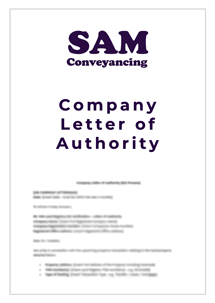
The corporate entity must draft a letter granting you authority to act on behalf of them in relation to a specific property/title number. The wording needs to be correct for the Land Registry. You can download our Land Registry-compliant letter below.
- Suitable for ID2 Form Land Registry applications.
- Instant download.
- Easy to fill in.
Proof of ID
The Land Registry allows you to provide one piece of evidence from Section A, or two pieces of evidence from Section B. Here's what evidence is allowed from both sections.
Section A
You'll only need to provide ONE piece of evidence from the following:
- Current valid full passport – State the country of issue and the number of the passport;
- Current United Kingdom, EU, Isle of Man, Channel Islands photo-card driving licence (not a provisional licence) – State the number of the licence; or
- Current Biometric Residence Permit issued by the UK Home Office to a non-UK national resident in the UK – State the permit number.
If you don't have any of the above, then you'll need to provide TWO pieces of evidence from List B
Section B
You'll only need to provide TWO pieces of evidence from the following:
- Credit card bearing the Mastercard or Visa logo, an American Express or Diners Club card, or a debit or multi-function card bearing the Maestro or Visa logo which was issued in the United Kingdom and is supported by an original account statement less than three months old*;
- Utility bill less than three months old(1) ;
- Council tax bill for the current year;
- Council rent book showing the rent paid for the last three months;
- Mortgage statement for the mortgage accounting year just ended(1) ; or
- Current firearm or shotgun certificate.
(1) These must be postal statements; they must not be statements sent electronically.
How the ID5 Land Registry Video Link Process Streamlines Your ID2 Meeting
Historically, completing a corporate identity check required a company director or secretary to travel to a solicitor's office for a face-to-face meeting. This meant taking time out of the business day to physically present corporate paperwork and photo identification.
During COVID, the Land Registry introduced the ID5 Land Registry video link, which completely changes this process, allowing unrepresented corporate bodies to finalise their compliance checks entirely online. Instead of an in-person appointment, the remote workflow takes place over a video call. The process is as follows:
Obtain Company Letter of Authority
Complete ID2 Form
Have your ID verified over video with a solicitor
What Your Business Submits to the Land Registry
Once the video call is finished, the solicitor handles the administrative completion. They will sign Section B of your HM Land Registry ID2 form, complete the supplementary ID5 Form (the official Verification of Online Video Call certificate), and return the entire package to you along with the captured screenshot.
Your company then submits this combined package directly to HM Land Registry to successfully finalise your property application without a conveyancer.
ID2 Form Warning!
Frequently Asked Questions About the ID2 Form

Andrew Boast FMAAT is a qualified accountant, conveyancing specialist and author with over 25 years of experience in the UK property sector. Since beginning his career in 2000 within established SRA and CLC-regulated conveyancing solicitor firms, Andrew has overseen the legal journeys of more than 75,000 clients.
He is the self-published author of the first-time buyer guide: How to Buy a House Without Killing Anyone, and a frequent contributor to mainstream UK media on legislative updates, property law, first-time buyer guides, conveyancing best practices, and stamp duty changes. Andrew specialises in resolving complex title issues, property conflict disputes, and property tax options, streamlining the enquiry process to reduce transaction times and maintaining a client-friendly focus.

Amanda Ambler is a highly accomplished conveyancing specialist with over 15 years of dedicated experience across residential property law, legal compliance, and practice management. Having held senior roles, including Head of Legal Practice and Head of Conveyancing at established UK law firms, Amanda possesses a profound, hands-on understanding of the technical intricacies of the property market.
As the designated Legal Content Reviewer for SAM Conveyancing, Amanda ensures that every guide, legal update, and resource published meets the absolute highest standards of accuracy, regulatory compliance, and factual integrity. Her rigorous review process guarantees that complex property legislation and industry processes are communicated clearly, transparently, and safely for home buyers and sellers alike.