What is a Planning Report?

- When you're buying a property and planning renovations, it would be useful to know what planning has been approved or refused on your property and on the surrounding ones.
- A Planning Report will give you information on all planning permissions from the past 10 years. You can read an example report below.
- You can order this search for a fixed fee of £72 INC VAT and the turnaround time is up to 2 working days*.
A Planning Report delivers planning permission data from the last 10 years worth of information stored at the Local Authority about your property, your neighbours and commercial developments in the local area. The report is provided by Future Climate Info and includes the following sections:
|
|
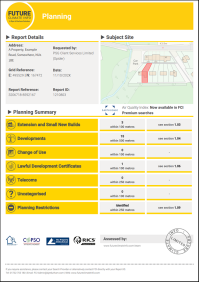
What does each section of the Planning Report include?
Section | What's included | Radius to Property |
| Extension and Small New Builds | Local Authority Planning Data will indicate if one or more extension, conversion or new build planning applications have been submitted within 100 metres of the property within the last 10 years. This section captures applications which would typically be considered by the average property purchaser as being minor when considering the possible scale of development. As such, this section will mostly include applications for property extensions, or the construction of only small number (1-2) of new build units. | within 100 metres |
| Developments | In this section we capture planning applications relating to commercial or residential development, which would reasonably be considered by the average property purchaser as being moderate or major in scale. Therefore, this section will mostly comprise development applications relating to three or more units, but extending up to large national housebuilder projects or major commercial developments. | within 500 metres |
| Change of Use | Land and buildings are put into various categories known as ‘use classes’, which are defined within the Town and Country (Use Classes) Order 1987 (as amended). A change of this use class will often require a planning application. This section is intended to identify and draw out those applications which, based on the data, relate to a Change of Use scenario. | within 100 metres |
| Lawful Development Certificates | Lawful Development Certificates (or Certificates of Lawfulness) are issued by Local Planning Authorities to certify that an existing or proposed development (or the use of the land/property) is lawful. ‘Lawful Development’ is considered to be development or use which is not in breach of any planning enforcement or condition notice, and against which the Local Planning Authority cannot take any enforcement action. This section is intended to identify and capture applications which, based on the data, relate to an attempt to obtain a Lawful Development Certificate. | within 100 metres |
| Telecoms | Applications which make reference to the development of telecommunications equipment such as radio and mobile phone masts. | within 250 metres |
| Uncategorised | This ‘Uncategorised’ section includes any applications where the data or description of the application does not group it with one of the above predetermined categories. | within 100 metres |
| Planning Restrictions | Additional planning controls may be in place where specific land use designations exist on the property or in the surroundings. These planning controls may restrict the ability to develop a property or make alterations, particularly to the exterior. Such designations may include areas such as Conservation Areas or Listed Buildings. You should speak with your Local Authority Planning Department and/or Conservation Officer to understand the impact of these features on your ambitions for the property. Additionally, if identified within the property boundary some features such as Listed Buildings or Scheduled Monuments may require specialist maintenance and upkeep. | within 250 metres |
Find out what planning permission has been granted on your property or your neighbours for a fixed fee of £72 INC VAT.

Andrew Boast FMAAT is a qualified accountant, conveyancing specialist and author with over 25 years of experience in the UK property sector. Since beginning his career in 2000 within established SRA and CLC-regulated conveyancing solicitor firms, Andrew has overseen the legal journeys of more than 75,000 clients.
He is the self-published author of the first-time buyer guide: How to Buy a House Without Killing Anyone, and a frequent contributor to mainstream UK media on legislative updates, property law, first-time buyer guides, conveyancing best practices, and stamp duty changes. Andrew specialises in resolving complex title issues, property conflict disputes, and property tax options, streamlining the enquiry process to reduce transaction times and maintaining a client-friendly focus.

Amanda Ambler is a highly accomplished conveyancing specialist with over 15 years of dedicated experience across residential property law, legal compliance, and practice management. Having held senior roles, including Head of Legal Practice and Head of Conveyancing at established UK law firms, Amanda possesses a profound, hands-on understanding of the technical intricacies of the property market.
As the designated Legal Content Reviewer for SAM Conveyancing, Amanda ensures that every guide, legal update, and resource published meets the absolute highest standards of accuracy, regulatory compliance, and factual integrity. Her rigorous review process guarantees that complex property legislation and industry processes are communicated clearly, transparently, and safely for home buyers and sellers alike.



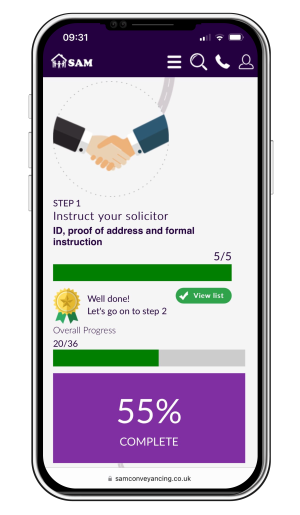
Our conveyancing process area includes:
- online checklists
- videos
- free downloads
- useful tips
It is completely free to use - from start to finish - and saves your progress along the way.
Bonus: Get a FREE book: House to Buy a House without Killing Anyone (Value £9.99).