How to Legally Deal With a Blocked Driveway

Discovering you’ve been blocked in or out of your own property by an inconsiderate driver is one of the most frustrating experiences a homeowner can face. While Highway Code Rule 243 advises against parking across property entrances, many caught in this situation wonder: can you park across a driveway legally? The answer depends entirely on your local authority. They can only enforce this as a civil offence if the driveway is served by a formally authorised, council-approved dropped kerb.
Under the Traffic Management Act 2004, blocking a licensed crossover allows councils to issue an immediate Penalty Charge Notice (PCN) or tow the vehicle. However, a major legal loophole catches thousands of UK property owners off guard: if your driveway lacks an officially licensed council crossover, parking wardens cannot fine the driver. Worse still, without that dropped kerb, you may technically be committing an offence under the Highways Act every time you drive across the pavement yourself.
This guide strips away the legal jargon to explain your precise blocked driveway legal rights, the hidden traps unsuspecting homebuyers must look out for, and the lawful steps you can take to clear your access.
- No licence, no enforcement: Councils can only issue a Penalty Charge Notice (PCN) if your driveway is served by an officially licensed, council-approved dropped kerb.
- Blocked IN vs blocked OUT: Councils can fine vehicles blocking an official crossover, but if you are trapped inside your property, it becomes a police matter for wilful highway obstruction.
- Homebuyer risk: Having off-street parking does not guarantee legal access; driving over a pavement without a licensed crossover is technically unlawful under the Highways Act.
- Costly legalisation: Installing or regularising a dropped kerb requires an approved contractor and council approval.
As seen in Surrey Live
"The road belongs to everyone, and your neighbour is technically entitled to park there, however frustrating that may be. The first step is always a calm, direct conversation. Most parking disputes are resolved quickly this way. If that fails, your local council may be able to help if the vehicle is causing an obstruction, blocking a dropped kerb or violating any parking restrictions in the area."
— Andrew Boast FMAAT, CEO of SAM Conveyancing
The legal distinction between driveways and approved crossovers
Many homeowners and buyers are caught off guard by the fact that having a garage, a gravel driveway, or a paved parking pad inside your property boundary does not automatically give you the legal right to drive over the pavement.
To cross the public footway legally in a motorised vehicle, the property must be served by an official vehicle crossover (a dropped kerb). This is a section of pavement specifically reinforced and lowered to the road level by the local council under a Section 184 License.
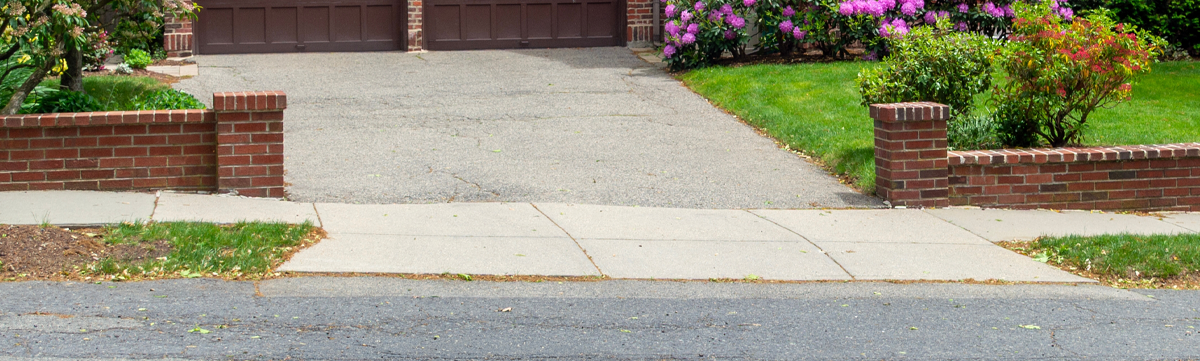
A common trap occurs when the only lowered kerb outside a property is a pedestrian-use crossing, which is often marked with textured tactile paving to assist wheelchair users and pushchairs. Using a pedestrian dropped kerb to access a private driveway remains unlawful under Sections 72 and 184 of the Highways Act 1980. If your access point lacks formal vehicular approval, crossing the pavement means you may technically be committing an offence, and you will lose the right to have obstructing vehicles fined.
The legislation: Highway Code Rule 243 and council powers
Navigating driveway access relies on a mixture of national statutory legislation, local civil powers, and nuisance parking laws in the UK. If the vehicle is blocking a dropped kerb, it is a council matter, not a police matter. Local authorities have the power to issue an immediate fine under civil parking enforcement.
Local council weapon: Traffic Management Act 2004
If there is a dropped kerb and a car overhangs even slightly, it is an automatic contravention. The council doesn't need yellow lines to issue a Penalty Charge Notice (PCN) as the dropped kerb is the restriction.
In a common enforcement area, a vehicle must not be parked on the carriageway adjacent to a footway, cycle track or verge where... the footway, cycle track or verge has been lowered to meet the level of the carriageway for the purpose of assisting vehicles to enter or leave the carriageway.
Source: Traffic Management Act 2004
Expert Tip: Why you might not legally own the space outside your driveway
Speaking to The Daily Express, , Andrew Boast, CEO at SAM Conveyancing, shared that many homeowners assume they have an exclusive right to park on the road outside their home, or block it themselves,but legally, that's rarely the case.
He shared that council enforcement often comes down to one critical factor: "Is your dropped kerb an officially licensed council crossover?""Under the Traffic Management Act 2004, councils can only issue a Penalty Charge Notice (PCN) if the crossing is an official Section 184 licensed crossover. Unlicensed dropped kerbs simply can't be enforced.
Andrew also warned that the law draws a sharp line when it comes to obstruction: "Being blocked out and being blocked in are treated very differently." While a vehicle blocking you in your driveway prevents access to the public highway and can be reported as a nuisance or obstruction, a vehicle blocking you out of your space generally isn't treated with the same urgency unless an officially recognised dropped kerb is being blocked.
CEO of SAM Conveyancing
Police power: wilful obstruction of the highway
If a driver is trapped inside their driveway and cannot physically leave to get to work or an appointment, this crosses into a police problem. The police will rarely show up if a car stops you from parking on your drive, but if you are blocked in, it becomes a "wilful obstruction of the highway". This gives the police the power to intervene, track down the owner, or even arrange a removal under Section 99 of the Road Traffic Regulation Act 1984.
No person in charge of a motor vehicle or trailer shall cause or permit the vehicle to stand on a road so as to cause any unnecessary obstruction of the road.
Source: Regulation 103 of the Road Vehicles (Construction and Use) Regulations 1986
The dangerous parking card
If the way a vehicle is parked poses a genuine danger, such as forcing pedestrians into a busy road or completely blinding a junction's line of sight. In this case, don't just report a blocked driveway; if the obstruction forces wheelchair users or prams off the pavement and into traffic, report it to 101 immediately as dangerous parking.
Why the council or police might refuse to act
If a vehicle blocks your driveway and you have an authorised vehicle crossover, the vehicle has committed a clear civil parking contravention. Government enforcement guidelines specify that if even a single tyre or a fraction of a bumper overhangs any part of the dropped kerb (including the sloped transition stones), the council can issue a fine.
However, if your driveway lacks an approved dropped kerb, your local council's Civil Parking Enforcement (CPE) powers do not apply. You are left entirely dependent on the police enforcing general obstruction laws.
If you are trying to drive into your empty driveway from the road, they will rarely intervene, as you do not have a legal right to cross that specific section of pavement without an authorised crossover.
Important Nuances for Homeowners:
- Parking across your own kerb: Under the Traffic Management Act 2004, you (or your house guests) can generally park across your own dropped kerb with your own consent. However, this exception disappears if you live in a Controlled Parking Zone (CPZ) or if yellow lines are painted across your layout. In those areas, the council can fine you for blocking your own driveway.
- The white H-bar Line: You can apply to your council to have a white "H" mark painted on the road across your driveway. While it carries no independent legal power, it serves as an undeniable psychological deterrent for drivers and helps parking wardens quickly identify your legal access limits, thereby speeding enforcement. This typically costs an extra £80 to £150 via your local council.
Blocked driveway: what to do and reporting laws
If an inconsiderate vehicle is blocking your access, you must follow the correct legal framework to resolve the issue. Do not attempt self-help measures like clamping, damaging, or using your own vehicle to pin the offending car in; doing so exposes you to civil liability and criminal damage charges.
Parking scenario | Enforcing authority | Likely outcome |
Parked across an authorised dropped kerb (CPE Area) | Local Council Parking Team | Penalty Charge Notice (PCN) issued via reactive hotline enforcement; potential tow-away if blocking emergency routes. |
Parked across an authorised dropped kerb (Non-CPE Area) | Police (Non-emergency 101) | Fixed Penalty Notice for obstruction (subject to police priority). |
Vehicle blocking a driveway with no dropped kerb | Police (Only if vehicle is trapped inside) | Verbal warning to driver or obstruction notice. Council cannot fine. |
Vehicle parked directly on your private driveway land | Civil Matter (Trespass law) | Police and Council cannot remove it. Requires a civil court injunction. Under the Protection of Freedoms Act 2012 it is a criminal offence to clamp, lock away, or tow a vehicle on private land yourself. Do not try to "trap" or retaliate against the driver. |
The step-by-step resolution process
- Attempt polite contact: Check if the vehicle belongs to a neighbour or a nearby delivery driver. A calm conversation or a polite note on the windscreen resolves the vast majority of incidents.
- Verify council powers: Visit your local authority's online portal to confirm they operate under Civil Parking Enforcement (CPE).
- Register your kerb: Some local authorities (such as the London Borough of Ealing or Bromley Council) require residents to pre-register their vehicles, and their dropped kerb footprint, before parking wardens will actively enforce the zone.
- Report the contravention (reactive enforcement): Most local authorities operate on a purely reactive basis for residential areas, and they will not spot it on a routine patrol. You must call your council’s dedicated parking enforcement hotline directly to prompt a warden dispatch. Provide them with the vehicle’s make, model, colour, and registration plate.
- Utilise 101 for complete trapping: If your vehicle is entirely blocked from leaving your property and the council lacks civil powers, dial 101 to report an unlawful obstruction of the highway to the police non-emergency line.
Expert Tip: Don't assume a dropped kerb is legal
When you are purchasing a property that features a front-garden driveway or off-street parking, never assume the dropped kerb is legal. Standard local authority searches do not automatically flag whether a physical dropped kerb is covered by an official council charter or license. If a previous owner installed an illegal driveway, dropped kerb or hired an uncredited builder to smash down the kerbstones without permission, you will inherit a major liability.
CEO of SAM Conveyancing
The cost of installing or regularising a crossing
If your property has a driveway space but lacks the corresponding legal pavement crossover, you must fund the formal application and construction process yourself. You cannot hire a standard domestic builder as the work must be carried out by a contractor accredited under the New Roads and Street Works Act 1991.
- Council application and administration fee: £81 to £340+ (typically non-refundable, even if your application is rejected due to safety or visibility restrictions).
- Legal and Section 184 agreement fees: Approximately £375 (Where required by specific borough frameworks).
- Approved contractor installation costs: £1,500 to £3,500+ (Dependent on the width of the crossing, the number of kerbstones to be lowered, and reinforcement layers needed to protect underground utilities).
- Street furniture relocation: Charged at cost (If a street lamp, parking bay sign, or utility box sits within one metre of your proposed crossing, relocating it can add £1,000 to £4,000 to your budget).
How long does council approval take?
Securing a legal dropped kerb is a multi-month administrative process. If you are preparing to put your home on the market, resolving an unlicensed dropped kerb early is critical.
- Straightforward council approval: 4 to 12 weeks for standard processing, site inspection, and approval.
- Complex cases (planning permission required): 3 to 6 months. Planning permission is mandatory if your property sits on a classified A, B, or C road, is located within a conservation area, or is a listed building.
- The construction window: Once the council issues your Section 184 Licence, most local authorities grant a strict 3-month permit window during which your approved contractor must complete the physical pavement works.
Expert Tip: Instruct your solicitor early
If you are selling your property within the next twelve months and discover your driveway is unlicensed, do not wait for the buyer's surveyor to find it. A pending application offers zero legal security to a mortgage lender. Instruct your conveyancing solicitor to review your property access rights the moment your home goes on the market to prevent your chain from collapsing.
CEO of SAM Conveyancing
If a vehicle is currently blocking your driveway:
- Check for a dropped kerb: Confirm that the kerb outside your property line is explicitly lowered to road level and contains sloped transition stones.
- Attempt direct communication: Look for the driver or place a polite note on the dashboard before initiating a formal dispute.
- Contact council parking enforcement: If your council operates under Civil Parking Enforcement powers, report the vehicle registration and make directly to their hotline to request reactive enforcement.
- Call 101 ONLY if trapped: Contact the police on the non-emergency line if you are completely prevented from exiting your property and the council cannot assist.
If you are buying a property with a driveway:
- Verify the Section 184 Licence: Request that your conveyancer obtain written proof of council approval for the vehicular crossing.
- Check the TA6 property form: Confirm the seller has formally declared the parking status and any historical boundary or parking disputes.
- Inspect the kerb style: Ensure the lowered kerb is a designated vehicle crossover and not a pedestrian-use tactical crossing point, which grants no vehicular access rights.
- Address defects before exchange: If the crossing is unlicensed, demand that the seller cover the cost of an indemnity insurance policy or discount the property price to cover structural legalisation.
Get help with your property disputes
Dealing with a difficult neighbour? If a blocked driveway is turning into a serious boundary or right-of-way issue, you don't have to fight it alone. Speak to our property dispute specialists to find out exactly where you stand legally and how to resolve it smoothly.
Frequently asked questions about property disputes

Ellie is a property content writer at SAM Conveyancing, specialising in guiding first-time buyers through the complexities of the UK property market. With experience translating intricate legal jargon into practical, actionable advice, Ellie has helped thousands of aspiring homeowners navigate everything from saving for a deposit to exchange and completion.
Beyond legal guides, her property and home-improvement insights have been featured in leading industry publications. Ellie is also a regular contributor to SAM Conveyancing’s professional network on LinkedIn, keeping buyers and industry pros updated on the latest market trends.