
How to make a Statutory Declaration of Solvency: Gifting Your House

When you gift a property or sell it significantly below its market value, you are entering into what the law calls a transfer at undervalue. While this is a common way to help family members, it triggers strict rules under the Insolvency Act 1986.
To ensure the gift cannot be overturned by future creditors, mortgage lenders and solicitors require a Statutory Declaration of Solvency. This legal document confirms that, at the time of the gift, you are able to pay all your debts and are not using the gift to hide assets from potential creditors in the event of bankruptcy. Without this declaration, the transaction may not be covered by Insolvency Indemnity Insurance, and lenders may deem the title defective.
A declaration of solvency is required for various transactions where someone is gifting away an asset. The types of transactions include:
- Ttransfer of equity
- Gifted Deposit
- Selling a house under market value
The above may be gifts for inheritance tax planning or gifts out of simple love for a family member to help them onto the housing ladder. The issue is when someone gives a gift but can't afford to repay all of their creditors, such as mortgages and loans. This means they aren't solvent and shouldn't gift assets.
A declaration of solvency avoids this as it is a legal promise that you have enough assets to repay your liabilities (debts). Making a false declaration is a criminal offence; you could go to jail.
Why do you need a declaration of solvency?
If you are gifting assets, or selling for a negligible fee when you can't meet your liabilities, the transaction could be reversed to pay off your debts. To declare you are solvent, your assets (money in the bank, car, jewellery or houses) must outweigh your liabilities (HMRC taxes, loans, mortgages, contracts with suppliers). If you were made bankrupt after the gift, the transaction could be reversed to sell the property to pay off the creditors. Mortgage lenders would be at risk of not getting repaid, which is why they ask for a declaration and also Insolvency Indemnity Insurance.
Insolvency Act 1986: Section 339 - Transactions at an undervalue
(1)Subject as follows in this section and sections 341 and 342, where an individual is adjudged bankrupt and he has at a relevant time (defined in section 341) entered into a transaction with any person at an undervalue, the trustee of the bankrupt’s estate may apply to the court for an order under this section.
(2)The court shall, on such an application, make such order as it thinks fit for restoring the position to what it would have been if that individual had not entered into that transaction.
Insolvency Act 1986: Section 339 - Transactions at an undervalue
What is the statutory declaration of solvency process?
- 1Check your assets outweigh your liabilities and that you are solvent.
- 2Make a declaration to a solicitor in the prescribed format IE you swear you are solvent.
- 3The solicitor signs a document which is your statutory declaration of solvency.
How do you know if you are solvent?
AssetsXT | Liabilities | Balance |
|
| |
£510,000 | £434,000 | £76,000 You are solvent. |
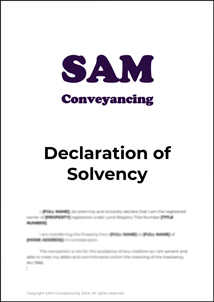
Download our declaration of solvency template in PDF or Word format, free from hassle.
- Instant download.
- Easy to fill in.
- Suitable format to evidence you are solvent.
The templates will be attached to your confirmation email after payment. Please allow a couple of minutes for the email to arrive.
What happens if you are insolvent?
It is a criminal offence to make a false declaration. Under section and sections 341 and 342, where an individual is adjudged bankrupt, and he has at a relevant time (defined in section 341) entered into a transaction with any person at an undervalue, the trustee of the bankrupt’s estate may apply to the court for an order under this section.
The court shall make an order as it thinks fit to restore the position to what it would have been if that individual had not entered that transaction. This could mean the gifted transfer is reversed.
What if you become insolvent in the future?
Under section 423 of the Insolvency Act 1986, the court has the power to unwind, reverse, gifts of money or property to your family if the gifts are for either putting assets beyond the reach of a person who is making or may at some time make, a claim against them or otherwise prejudicing a claim. In essence, you can't give away your assets knowingly that you can't afford your liabilities; however, what if today you can afford your liabilities, but in a year, that position changes?
In 2019, the High Court refused to make an order to unwind certain gifts to family made by someone before their bankruptcy. The gifts weren't seen as transactions defrauding creditors. The court found that the gifts were made for tax-planning purposes and were not transactions defrauding creditors. The case was Tate & anr v Robin Farrell & ors WTLR(w) 2019-07.

Andrew Boast FMAAT is a qualified accountant, conveyancing specialist and author with over 25 years of experience in the UK property sector. Since beginning his career in 2000 within established SRA and CLC-regulated conveyancing solicitor firms, Andrew has overseen the legal journeys of more than 75,000 clients.
He is the self-published author of the first-time buyer guide: How to Buy a House Without Killing Anyone, and a frequent contributor to mainstream UK media on legislative updates, property law, first-time buyer guides, conveyancing best practices, and stamp duty changes. Andrew specialises in resolving complex title issues, property conflict disputes, and property tax options, streamlining the enquiry process to reduce transaction times and maintaining a client-friendly focus.

Amanda Ambler is a highly accomplished conveyancing specialist with over 15 years of dedicated experience across residential property law, legal compliance, and practice management. Having held senior roles, including Head of Legal Practice and Head of Conveyancing at established UK law firms, Amanda possesses a profound, hands-on understanding of the technical intricacies of the property market.
As the designated Legal Content Reviewer for SAM Conveyancing, Amanda ensures that every guide, legal update, and resource published meets the absolute highest standards of accuracy, regulatory compliance, and factual integrity. Her rigorous review process guarantees that complex property legislation and industry processes are communicated clearly, transparently, and safely for home buyers and sellers alike.