Leaseholder Protections

Key Takeaways
- Leaseholder protections came into force with The Building Safety Act 2022
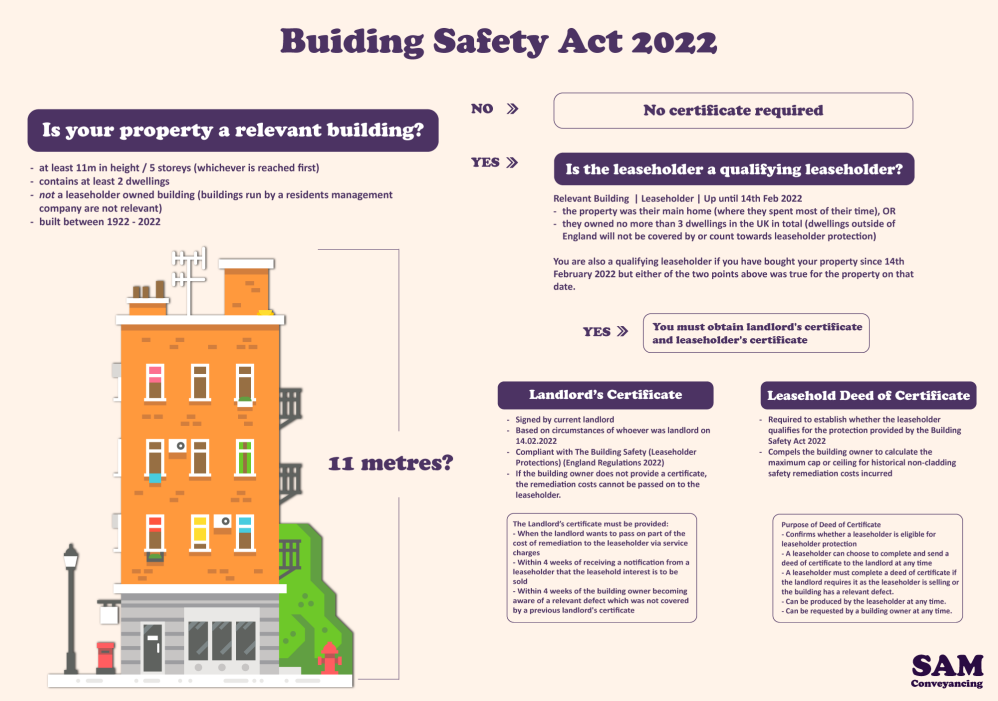
- It applies to buildings over 11 metres or 5 storeys, for buildings built between 28th June 1992 and 27th June 2022 for Qualifying Leaseholders as at the 14th February 2022
- Qualifying leaseholders are protected from the financial burden of remediation costs concerning building safety
- Sellers will need a Leaseholders Deed of Certificate to confirm to buyers that the leasehold is subject to leaseholder protections
- Since the enaction of the Levelling-up and Regeneration Act 2023, leaseholder protections are transferred to the new lease or owner in sale and extension.
- Higher risk buildings (HRBs) are over 18 metres (or seven stories) with two or more dwellings, and are treated slightly differently. HRBs built since October 2023 must have a specific digital record to confirm they are safe and can be legally occupied. (The Building (Higher-Risk Buildings Procedures) (England) Regulations 2023).
The Leasehold and Freehold Reform Act 2024 was passed on the 24th May 2024, but is not fully enforced yet and the date for this is not yet clear. We will update our content as and when the finalised legislation is published.
What is leasehold protection?
Do leaseholder protections apply to me?
- it is at least 11 metres in height or has at least five storeys (whichever is reached first)
- it contains at least two dwellings
- it is not a leaseholder-owned building
- Commonhold buildings
- Leaseholder owned buildings
- it puts people’s safety at risk from the spread of fire or structural collapse
- it has arisen from work done to a building, including the use of inappropriate or defective products, during its construction, or any later works (such as refurbishment or remediation)
- it has been created in the 30 years prior to the leaseholder protections coming into force (28 June 1992 to 27 June 2022), and
-
it relates to at least one of the following types of works:
- the initial construction of the building,
- the conversion of a non-residential building into a residential building, or
- any other works undertaken or commissioned by or on behalf of the building owner, or management company.
- Wear & tear
- Routine maintenance
- it is a long lease (more than 21 years in length) of a single dwelling within a building of above 11 metres or at least five storeys
- you are responsible for paying a service charge
- the lease was granted before the 14 February 2022
-
on 14 February 2022:
- the dwelling was your only or main home, meaning it was the home where you spent most of your time, or
- you did not own more than 3 dwellings in the United Kingdom in total - please note, dwellings outside of England will not be covered by the leaseholder protections.
- it is in England.
- in Wales,
- in Scotland, or
- in Northern Ireland
Do I need a Deed of Certificate?
How do I get a Deed of Certificate?
Is there a time limit to produce a Deed of Certificate?
- your lease will be treated as though it is not a qualifying lease
- your building owner may assume that you own a 100% share, even if your lease is shared ownership
- the qualifying lease may be deemed to have a higher value
What legal rights do leaseholders have?
- extend the lease or buy the freehold of a house under the Leasehold Reform Act 1967
- extend the lease or buy the freehold of a flat provided that certain criteria are met
- buy the freehold of a flat when it is sold, under the Landlord and Tenant Act 1987
- pay a service or administration charge in as far as it is 'reasonable', and to be consulted about certain works
- have information on how to challenge service charges
- form a company which can take over responsibility for management of the block
- avoid repossession for arrears of ground rent or service charges when the debt is relatively low

Andrew Boast FMAAT is a qualified accountant, conveyancing specialist and author with over 25 years of experience in the UK property sector. Since beginning his career in 2000 within established SRA and CLC-regulated conveyancing solicitor firms, Andrew has overseen the legal journeys of more than 75,000 clients.
He is the self-published author of the first-time buyer guide: How to Buy a House Without Killing Anyone, and a frequent contributor to mainstream UK media on legislative updates, property law, first-time buyer guides, conveyancing best practices, and stamp duty changes. Andrew specialises in resolving complex title issues, property conflict disputes, and property tax options, streamlining the enquiry process to reduce transaction times and maintaining a client-friendly focus.

Amanda Ambler is a highly accomplished conveyancing specialist with over 15 years of dedicated experience across residential property law, legal compliance, and practice management. Having held senior roles, including Head of Legal Practice and Head of Conveyancing at established UK law firms, Amanda possesses a profound, hands-on understanding of the technical intricacies of the property market.
As the designated Legal Content Reviewer for SAM Conveyancing, Amanda ensures that every guide, legal update, and resource published meets the absolute highest standards of accuracy, regulatory compliance, and factual integrity. Her rigorous review process guarantees that complex property legislation and industry processes are communicated clearly, transparently, and safely for home buyers and sellers alike.