
What is a Section 21 Counter Notice from a Freeholder?

Key Takeaways
- Your freeholder can't refuse to sell you the freehold, if you are eligible
- If the freeholder fails to issue the section 21 notice, the freeholder may apply for a vesting order
- If both parties cannot agree on the terms and premium for the purchase, the Tribunal can determine them fairly
- There are time limits for each stage if you have to go through Tribunal
The Leasehold and Freehold Reform Act 2024 was passed on the 24th May 2024, but is not fully enforced yet and the date for this is not yet clear. We will update our content as and when the finalised legislation is published.
- 1
- the landlord admits the participating tenants are entitled to purchase the freehold; or
- the landlord does not admit the participating tenants are entitled to purchase the freehold and to specify why not; or
- the landlord intends to redevelop the whole or a substantial part of the specified premises
- 2
- what proposals are accepted, if any; or
- if the proposals are not accepted, such as the premium, in which case the counter notice must offer a counter proposal; or
- if (in a case where any property specified in the initial notice under section 13(3)(a)(ii) is property falling within section 1(3)(b)) any such counter-proposal relates to the grant of rights or the disposal of any freehold interest in pursuance of section 1(4), specify the nature of those rights and the property in respect of which it is proposed; and
- state which interests (if any) the nominee purchaser is to be required to acquire; and
- states which rights (if any) the landlord wishes to keep.
- 3
- 4
- 5
What are the time constraints?
- The freeholder must serve their Section 21 Counter Notice on or before the date stated in the Section 13 Notice.
- If the counter notice rejects any of the terms of the initial notice, the leaseholders and freeholder have 2 months after the date stated in the counter notice to negotiate the terms and premium.
- After the first 2 months, the leaseholder has 4 months to make an application to the Tribunal to determine the terms/premium of the purchase of freehold.
- The leaseholder and freeholder have 4 months after the date they both agreed to the terms to complete the purchase of freehold. If there is a delay, neither party can make an application to court for the first 2 months after terms are agreed ('Appropriate Period'), however they should make an application for a court order in the 3rd month. You cannot make an application after 4 months.
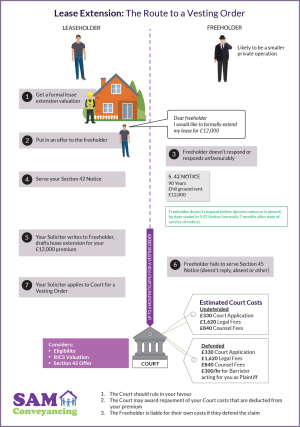
What happens if the landlord fails to serve a counter notice?
Arrange a free consultation with one of our experienced conveyancing executives on:

- Lease extension.
- Purchasing the leasehold, freehold or share of freehold.
- Selling a leasehold property with a short lease.
- Extending the lease at the same time as you sell.
We specialise in lease extensions and have RICS valuers for the premium/negotiation and solicitors for the section 42 notice and formal or informal extension. Request a tailored quote for:
- RICS Lease Extension Valuation or L2 Homebuyers Survey.
- Serving of the section 42 notice or section 13 notice on the freeholder.
- Negotiation with the freeholder (with the support of your RICS valuer).
- Completion of the legal work, including deed of variation.
- Application to Tribunal to determine the premium.
- Vesting order for absent landlords.

Andrew Boast FMAAT is a qualified accountant, conveyancing specialist and author with over 25 years of experience in the UK property sector. Since beginning his career in 2000 within established SRA and CLC-regulated conveyancing solicitor firms, Andrew has overseen the legal journeys of more than 75,000 clients.
He is the self-published author of the first-time buyer guide: How to Buy a House Without Killing Anyone, and a frequent contributor to mainstream UK media on legislative updates, property law, first-time buyer guides, conveyancing best practices, and stamp duty changes. Andrew specialises in resolving complex title issues, property conflict disputes, and property tax options, streamlining the enquiry process to reduce transaction times and maintaining a client-friendly focus.

Amanda Ambler is a highly accomplished conveyancing specialist with over 15 years of dedicated experience across residential property law, legal compliance, and practice management. Having held senior roles, including Head of Legal Practice and Head of Conveyancing at established UK law firms, Amanda possesses a profound, hands-on understanding of the technical intricacies of the property market.
As the designated Legal Content Reviewer for SAM Conveyancing, Amanda ensures that every guide, legal update, and resource published meets the absolute highest standards of accuracy, regulatory compliance, and factual integrity. Her rigorous review process guarantees that complex property legislation and industry processes are communicated clearly, transparently, and safely for home buyers and sellers alike.