Property Subsidence Reports Explained

One of the greatest financial risks to a property is subsidence. Subsidence occurs when the foundations of a property move, causing structural cracking or, in the worst cases, the complete collapse of part or all of the building.
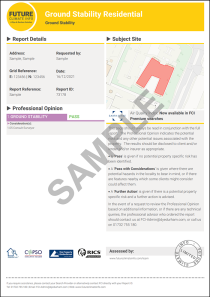
A Subsidence Report (also known as an FCI Ground Stability Report) is a detailed desk-study assessment that informs buyers if the property they intend to purchase is located in an area affected by ground instability, soil shrinkage, or historical mining activity.
- Checking for subsidence is one of the most critical checks during the home-buying process.
- Subsidence can be caused by several different factors, such as nearby trees, historical coal mining activity, clay subsoils, or leaking drains.
- Repairing a property with active movement can cost tens of thousands of pounds and, in severe cases, may even require the property to be completely rebuilt.
- If there is known subsidence at the property, your home insurance policy may be invalidated.
- This subsidence report provides a clear risk rating and vital information regarding any remedial work that may need to be undertaken.
- This report costs £45 INC VAT, with a fast turnaround time of just 2 working hours.
How do you check for subsidence?
You can check if your prospective property is affected by subsidence through the following three steps:
- Subsidence Report: This is the ideal starting point. It is a fast, data-driven desk search used to flag a property's potential risk based on its location and local history. You would opt for this first to assess the baseline risk potential.
- RICS Home Survey: You should always instruct a RICS surveyor to physically inspect the property before buying it. Included within their report is a visual inspection of the building's fabric to flag any current or historic signs of movement, such as structural cracking.
- Subsidence Survey (Structural Engineer): You would order this highly specialised survey if a potential risk is flagged by your RICS surveyor or the mortgage lender's valuation report. A qualified structural engineer inspects the property to confirm if there is active movement. If there is, they can be instructed to complete an intrusive survey of the footings to confirm the exact strengthening works required to protect the property.
Do you need a Subsidence Report?
Order a subsidence search and put your mind at ease.
- Check for subsidence, landslide risks, and geology, mining and other hazards in the surrounding area.
- Find any damage claims for subsidence on your property and the surrounding area.
- Report delivered within 2 working hours.
- Fixed fee of £45 INC VAT.
What is included in a Subsidence Report?
The report is broken down into clear, easy-to-understand sections to help you and your conveyancer accurately assess the property's risk:
Report Section | What is covered? |
|---|---|
| Overall Risk Assessment | Located at the very top of the report, this provides an immediate, overarching opinion of your property's level of subsidence risk (ranging from Low to Very High). |
| Professional Opinion | Explains in detail why the property has been assigned its specific risk rating and suggests practical ways you can take action to lessen the risk. |
| Detailed Subsidence Information | Provides an in-depth breakdown of the main causes and indirect factors affecting the site, including checks for Geohazards, Mapped Landslides, Slope Instability, Mining Activity, Modified Ground, Natural Cavities, and Soluble Rocks. |
| Remedial Work Guidelines | Explains what you should do if you have concerns, and outlines the exact certification any historical remedial work must have to be regarded as legally acceptable by your mortgage lender. |
| High-Risk Postcode Guide | An estimated 30% of postcodes in England and Wales have a high or very high risk rating based on geographical data. This section explains what further physical checks you should carry out if your postcode falls into this bracket. |
What is not included?
This report is a desk-based study and does not give full confirmation that your specific building currently has active subsidence. Instead, it highlights whether there are man-made or natural factors within 25 to 250 metres of the property that might affect its stability, allowing you to arrange a physical structural survey if necessary.
Expert Tip: When a Subsidence Report is the Wrong Choice
If your mortgage lender's valuation report has already flagged a risk of subsidence at the property, then a desk-based Subsidence Report is not the correct product to buy.
In this scenario, your lender will explicitly require you to instruct a qualified structural engineer to conduct a physical, non-intrusive inspection to confirm if the property is showing current signs of movement.
Where no active movement is found, the engineer will provide a formal 'letter of comfort'. This document gives the lender the exact reassurance required to approve the funds. Without this letter, the lender will simply not agree to the mortgage.
Managing Director & CEO of SAM Conveyancing
When do you order the subsidence survey?
During the conveyancing process, a subsidence survey is often flagged by solicitors as a requirement because it has been highlighted within the Environmental Report in the Ground Stability Section. Risks are flagged at the start of the report, as before, as ‘Identified’ or ‘None Identified'. Mortgage Lenders take subsidence very seriously and if they suspect that your property has any signs of subsidence, then they may not lend you the money until the issue is addressed.
Do you need a Subsidence Report?
Order a subsidence search and put your mind at ease.
- Check for subsidence, landslide risks, and geology, mining and other hazards in the surrounding area.
- Find any damage claims for subsidence on your property and the surrounding area.
- Report delivered within 2 working hours.
- Fixed fee of £45 INC VAT.
Frequently Asked Questions

Andrew Boast FMAAT is a qualified accountant, conveyancing specialist and author with over 25 years of experience in the UK property sector. Since beginning his career in 2000 within established SRA and CLC-regulated conveyancing solicitor firms, Andrew has overseen the legal journeys of more than 75,000 clients.
He is the self-published author of the first-time buyer guide: How to Buy a House Without Killing Anyone, and a frequent contributor to mainstream UK media on legislative updates, property law, first-time buyer guides, conveyancing best practices, and stamp duty changes. Andrew specialises in resolving complex title issues, property conflict disputes, and property tax options, streamlining the enquiry process to reduce transaction times and maintaining a client-friendly focus.

Amanda Ambler is a highly accomplished conveyancing specialist with over 15 years of dedicated experience across residential property law, legal compliance, and practice management. Having held senior roles, including Head of Legal Practice and Head of Conveyancing at established UK law firms, Amanda possesses a profound, hands-on understanding of the technical intricacies of the property market.
As the designated Legal Content Reviewer for SAM Conveyancing, Amanda ensures that every guide, legal update, and resource published meets the absolute highest standards of accuracy, regulatory compliance, and factual integrity. Her rigorous review process guarantees that complex property legislation and industry processes are communicated clearly, transparently, and safely for home buyers and sellers alike.