
Pitfalls to Avoid When Buying a House with a Septic Tank

Moving to a rural or semi-rural property often introduces homeowners to private sewage infrastructure. While living off the main sewer network offers a unique sense of independence, buying a house with a septic tank can quickly become a significant financial and legal liability if it is not thoroughly evaluated before exchanging contracts.
Under modern environmental enforcement and evolving septic tank regulations in the UK, inheriting a defective or non-compliant tank can mean you face an immediate structural upgrade, which can cost between £8,000 to £18,000. Alongside this is the risk of prosecution for environmental pollution.
These figures can surprise any buyer, but structural risks are entirely manageable if caught during the initial property searches. By coordinating specialised technical inspections with having proper contractual protections during the conveyancing stage, you can completely insulate your investment.
- High non-compliance costs: Replacing a defective septic tank costs £8,000 to £18,000, plus risks of prosecution under EA regulations.
- Mortgage refusal risk: Lenders will view non-compliant private sewage systems as defective security and could refuse financing.
- Hidden structural defects: Standard RICS home surveys miss underground issues, which makes a £350 to £600 CCTV drainage survey essential.
- Essential legal checks: Conveyancers must verify the seller’s Disclosure Notice, TA6 form, land easements, and CON29DW water search.
How traditional off-mains infrastructure separates and discharges waste
A septic tank (or a cesspit) is often required for properties not connected to the mains drainage system. They have developed over time as a solution for homes that can't connect to their nearest drainage or sewage treatment plant.
Traditionally, a septic tank acts as a passive settlement chamber. Raw effluent enters the primary compartment, where heavy solids settle to the floor as sludge, while fats, oils and greases rise to the surface to form a scum layer. The clarified liquid effluent between these layers passes through internal baffles or partition walls, which help retain solids within the tank, before discharging via the outlet to a dedicated drainage field. This field consists of a network of perforated pipes laid in gravel trenches, allowing the water to slowly percolate down where natural soil bacteria provide final biological treatment.
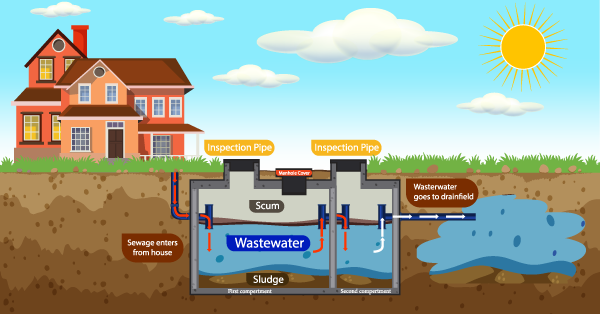
Waste that is not discharged should be removed from the holding tank. The tank emptied regularly of the accumulated sludge at the bottom to ensure a well-maintained system.
Some systems require pumping or emptying every few years, but an older domestic sewage treatment system with a small tank used by a large family would require much more frequent pumping.
Know what system you are adopting
It is a common pitfall to confuse this with a cesspit, which is merely a sealed holding tank with no outlet, or a modern sewage treatment plant, which uses active mechanical aeration to purify wastewater to a high standard before release.
It brings an added dimension to your pre-purchase checks because not only will you have to understand how the equipment works, but you'll need to be aware of the implications of its pollution to the local ecosystem.
Cesspit or Septic Tank? Book a RICS Home Survey Today
- We offer RICS Level 2 or 3 Home Surveys.
- National Coverage
- Inspections by one of our panel of local RICS surveyors.
- Reports delivered within 5 working days.
- Competitive Fees from £375 EXC VAT for a Level 2 Home Survey.
Environmental rules governing private discharges
These systems are strictly governed by the Environment Agency through the General Binding Rules, all of which you should be aware of when buying a house with a septic tank. Under the statutory regulations, it is an offence to discharge untreated septic tank effluent directly into any surface watercourse, including streams, rivers, ditches, or canals. Septic tanks must only discharge to the ground through a properly constructed drainage field.
You must use a septic tank or a small sewage treatment plant to treat the sewage and then discharge the wastewater to the ground through a drainage field. You must not discharge effluent from a septic tank to a watercourse.
Furthermore, strict layout parameters dictate that if any part of the property's boundary is within 30 meters of a public foul sewer, the Environment Agency expects the system to be decommissioned in favour of a direct mains connection. The regulations also include specific proximity boundaries for systems that are installed or significantly altered, stating that no new discharge point may be located within 50 metres of an existing exempt system to prevent excessive nutrient loading on local ground systems.
Why mortgage lenders mandate absolute regulatory compliance
Failing to verify the integrity and legal status of private drainage directly compromises your ability to secure financing. The principle of caveat emptor (buyer beware) places the entire technical burden onto the purchaser once contracts are signed.
According to Section 5.5.3 of the UK Finance Mortgage Lenders’ Handbook, conveyancing solicitors have a strict duty to verify that any private sewage installation complies with all active regional environmental laws. If a system fails to meet the legal criteria, major banks and building societies will view the property as a defective security. They will instantly refuse to release the purchase funds, resulting in an unmortgageable septic tank scenario that halts your property's progress entirely until a legally and financially binding remedy is executed.
How the CON29DW Water and Drainage Search identifies off-grid assets
During the initial stages of the transaction, your conveyancer instructs an official CON29DW Water and Drainage searches. This standardised report answers 23 critical questions using direct data from the regional water authority. For off-grid buyers, the search acts as an early warning system and confirms that the property is completely disconnected from the public mains sewerage network.
Crucially, the CON29DW also maps out public water mains and adoption assets. If the search reveals that a public sewer pipe passes through the boundary or is within 3 metres of the private tank infrastructure, the water authority holds statutory rights of entry. Your solicitor must then verify that a formal Build-Over Agreement exists to protect the property from future mandatory excavation or structural disputes.
What legal checks are performed during the conveyancing process?
To establish the technical and legal footprint of the system, your legal professional has to go through a systematic checking process:
- Analysis of the TA6 Form: The seller must explicitly detail the system's type, position, age, and maintenance frequency within this official document.
- Review of the statutory written Disclosure Notice: Under Rule 13 of the General Binding Rules, the seller is legally obligated to hand over a formal written statement confirming the exact discharge route, design capacity, and operational parameters of the tank.
- Deed and easement mapping: If the drainage pipes or the physical tank cross over into adjoining fields or third-party land, your solicitor must locate a formally registered deed of easement on the title deeds. This confirms permanent, transferable rights for maintenance, repair, and total system renewal when your solicitor handles the completion adjustments.
Expert Tip: Hidden hazard standard home surveys miss
Standard RICS surveys only offer basic visual checks and cannot assess subterranean drainage health. Without specialist CCTV equipment and engineering expertise, critical hidden risks go undetected. Internally fractured concrete baffles can allow untreated solids to escape, permanently clogging the soil matrix and forcing a complete, costly excavation and replacement.
Furthermore, if the system sits within a Groundwater Source Protection Zone 1 (SPZ1), standard legal exemptions are void. Property owners face heavily restricted Environmental Permit applications from the Environment Agency, which are frequently denied.
CEO of SAM Conveyancing
Financial costs of routine care and system upgrades
Managing a home with private infrastructure involves predictable operational costs alongside substantial risks if structural defects are uncovered:
- Pre-purchase drainage survey: A specialist inspection employing tractor-mounted CCTV cameras and structural dye testing generally falls within a £350 to £600 price bracket, representing a standard pre-purchase drainage survey cost UK baseline.
- Annual tank de-sludging: Depending on the capacity and household usage, a licensed waste carrier charges between £150 and £300 annually to pump out accumulated sludge solids.
- System upgrades: If a septic tank is found to be discharging into an open ditch, or if the soil has failed a percolation test, a full sewage treatment plant upgrade is required. Factoring in modern excavation, compliance certification, and electrical hookups, the total replacement cost generally ranges from £8,000 to £18,000.
Managing transaction timelines to prevent completion delays
Booking an accredited, independent off-mains drainage surveyor can introduce an additional 7 to 14 days to your conveyancing timeline. To maintain transaction momentum, instruct your solicitor to demand the seller's written disclosure notice, system layout diagrams, and empty logs on day one of instruction.
If a survey determines that the system sits in an SPZ1 area and requires a bespoke permit application to the Environment Agency, the approval process can take up to 4 months. Recognising these environmental constraints early ensures you can structure the contract appropriately without risking an eleventh-hour collapse of your chain.
Summary checklist for off-mains property buyers
Before you instruct your conveyancing team to exchange contracts, tick off these essential regulatory steps:
- The CON29DW validation: Ensure the drainage and water search explicitly outlines any public sewers or water mains interacting with your boundary.
- The 30-metre proximity check: Confirm via local water authority asset maps that the property boundary sits more than 30 metres away from the nearest public foul sewer.
- Discharge route verification: Ensure a CCTV survey proves the tank discharges into a legal subterranean drainage field, rather than an open stream, river, or rainwater soakaway.
- Shared infrastructure easements: If the installation serves neighbouring properties, ensure a robust cost-sharing agreement and registered right-of-way easements are clearly recorded on the title deeds.
- Historical maintenance audit: Review a minimum of 3 to 5 years of formal waste transfer notes from a registered waste carrier to confirm consistent de-sludging.
- Environmental overlay mapping: Verify through your solicitor's environmental search report that the active drainage field does not reside within a designated SPZ1 boundary.
Ready for your move?
If you have found your perfect property and want absolute legal certainty before you exchange contracts, we are ready to help. Our panel of special conveyancing solicitors will help you expertly audit your TA6 form, analyse your CON29DW water search, lock down your deed easements, and protect your investment.

Andrew Boast FMAAT is a qualified accountant, conveyancing specialist and author with over 25 years of experience in the UK property sector. Since beginning his career in 2000 within established SRA and CLC-regulated conveyancing solicitor firms, Andrew has overseen the legal journeys of more than 75,000 clients.
He is the self-published author of the first-time buyer guide: How to Buy a House Without Killing Anyone, and a frequent contributor to mainstream UK media on legislative updates, property law, first-time buyer guides, conveyancing best practices, and stamp duty changes. Andrew specialises in resolving complex title issues, property conflict disputes, and property tax options, streamlining the enquiry process to reduce transaction times and maintaining a client-friendly focus.

Amanda Ambler is a highly accomplished conveyancing specialist with over 15 years of dedicated experience across residential property law, legal compliance, and practice management. Having held senior roles, including Head of Legal Practice and Head of Conveyancing at established UK law firms, Amanda possesses a profound, hands-on understanding of the technical intricacies of the property market.
As the designated Legal Content Reviewer for SAM Conveyancing, Amanda ensures that every guide, legal update, and resource published meets the absolute highest standards of accuracy, regulatory compliance, and factual integrity. Her rigorous review process guarantees that complex property legislation and industry processes are communicated clearly, transparently, and safely for home buyers and sellers alike.