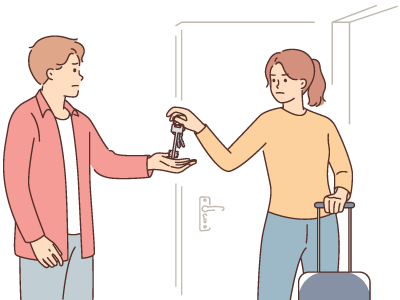
Force a House Sale When Unmarried

When you jointly own a property with an unmarried partner, friend, or family member, a relationship breakdown can leave you trapped. If the other person refuses to sell, you cannot unilaterally force them to sign the documents needed to sell. This often leaves you stuck on the legal title and tied to a mortgage for a property you no longer want.
However, there is a formal legal process to break the deadlock. You can apply to the civil court to force the sale under Section 14 of the Trusts of Land and Appointment of Trustees Act 1996 (TOLATA). Through this mechanism, a judge can issue a binding order compelling your co-owner to sell the property on the open market.
Forcing a sale through the courts is rarely cheap or straightforward. Furthermore, under Section 15 of TOLATA, judges must weigh several statutory factors before granting an order, such as the original intentions behind the purchase and the welfare of any children occupying the home, meaning an immediate sale is never guaranteed. In this article, we examine the application process, the different types of court orders, the costs involved, and the typical timescales.
Need further help? For more information on forcing a property sale, including guides on married owners forcing a sale in a divorce and whether you have rights to your partner's home, visit our comprehensive guide to property disputes.
- You cannot sell on your own: Both owners must agree and sign the conveyancing documents, unless you obtain a formal court order to force the sale.
- TOLATA provides a legal route: You can apply to the civil court for an Order for Sale under Section 14.
- Your ownership type matters: Joint tenants and tenants in common have different implications for ownership shares.
- You do not need to be on the title: A proven beneficial interest can give you grounds to apply for a sale.
- The court considers the bigger picture: Original intentions, children’s welfare, and creditors’ interests can all affect the outcome.
- Joint tenants vs tenants in common: impact on forced sales
- TOLATA section 15: How do courts decide whether to order a sale?
- When might a court refuse to force a property sale?
- How to apply for a court order for sale?
- Costs and legal fees for forcing a house sale
- What happens if you ignore a court Order for Sale?
- Forcing a sale without being on title deeds
- Facing a joint property dispute?
- FAQs
Why does it matter if you are joint tenants vs tenants in common?
The exact way you are registered at HM Land Registry fundamentally dictates what you actually own, how the sale proceeds will be divided, and what happens to your equity if you were to unexpectedly pass away before the dispute is resolved.
Joint tenants
Under this arrangement, you act together as a single legal entity. You do not own a distinct half or specific percentage of the property; rather, both owners jointly own 100% of the whole property.
- No distinct shares: You cannot independently sell or mortgage a separate share to a third party because distinct financial shares do not legally exist; you own the property altogether.
- The Rule of Survivorship: This is an issue and the main reason disputing joint owners look to sever the joint tenancy. If you are joint tenants and you pass away before the property is sold, your interest in the home automatically transfers to your co-owner, completely bypassing anything written in your will.
Tenants in common
This arrangement means you both own distinct, quantifiable equity shares in the property (for example, a 50/50 or 70/30 split), which are usually formally documented at the point of purchase via a Deed of Trust or on the original TR1 when you purchased the property.
- Protected inheritance: There is no automatic right of survivorship. If you pass away, your specific share forms part of your estate and safely passes to your chosen beneficiaries according to your will.
- The reality of selling a share: While you technically own a distinct financial share, finding a third-party buyer willing to purchase a partial percentage of an occupied residential house is virtually impossible. Therefore, a TOLATA court order is still required to compel the sale of the entire physical property so both parties can extract their respective financial shares.
Expert Tip: The pros and risks of severing a joint tenancy
During a dispute, severing a joint tenancy to become tenants in common is often a smart protective measure. Crucially, it stops the rule of survivorship, meaning if you pass away before the sale is resolved, your share goes to your heirs rather than automatically transferring to your ex-partner.
However, you must proceed with caution. While you can sever a joint tenancy without the other owner's consent, simply declaring that you now own a larger, unequal share (e.g. 70% instead of 50%) does not make it legally binding. Your co-owner can easily challenge this. Without a formal Deed of Trust already in place, proving unequal financial contributions becomes a very messy, costly, and lengthy legal battle.
CEO of SAM Conveyancing
- Sever the joint tenancy and register as tenants in common.
- Remove the right of survivorship, and state your unequal beneficial ownership.
- Sever with or without joint consent.
- Applications made digitally to the Land Registry within 5 working days.
- Fixed Fee of £260 INC VAT.

TOLATA section 15: How do courts decide whether to order a sale?
When deciding an application under Section 14, the court must consider the relevant factors set out in Section 15 of TOLATA. These include:
- Original intentions: What was the agreed purpose when purchasing the property? For example, was it intended to be a permanent family residence, a temporary stepping stone, or a commercial buy-to-let?
- Current purpose: Is the property actively fulfilling its original intended purpose? If a cohabiting relationship ends, the purpose of maintaining a joint home may no longer exist.
- Welfare of minor children: If a child occupies, or might reasonably be expected to occupy, the property as their home, the court must consider their welfare when deciding what order to make.
- Secured creditor interests: The court must consider the interests of any secured creditors when deciding what order to make.
What are the different Court Orders for forced sales?
The court can award one of five different types of orders:
Refuse a sale:
The court may decide not to order a sale at all.
This often happens when the property's original purpose (e.g., a family home for children) is still active, and ordering a sale would cause undue hardship or go against the initial intentions of the owners.
Proving original intentions in joint ownership disputes
To evaluate whether a sale should be ordered, judges compare the initial purpose of acquisition against present circumstances:
- Family home: If the property was acquired specifically to provide a home for a family, the court may consider whether that purpose can still be fulfilled.
- Home occupied by children: The children's welfare may weigh against an immediate sale.
- Investment property: If the property was acquired as an investment, the court may consider whether continuing to hold it still fulfils the original purpose.
When might a court refuse to force a property sale?
While co-owners have the right to apply for an Order for Sale, judges do not automatically grant them. Under Section 15, the court has full discretion to refuse an application or defer the sale if specific circumstances apply.
Statutory factor (Section 15) | How this may support a sale | How this may weigh against a sale |
|---|---|---|
Original intentions and purpose | The original purpose (e.g. a joint home or investment) has ended due to relationship breakdown. | The original purpose remains active (e.g. providing a home for a vulnerable or elderly dependent). |
Welfare of minor children | No minor children live in the property, or suitable alternative housing is readily available. | Minor children live in the home, and a forced sale would severely disrupt their education, health, or welfare. |
Alternative financial remedies | The residing co-owner cannot afford to buy out the applicant's equity share or cover the mortgage. | The residing co-owner offers a fair market buyout of the applicant's share or agrees to pay occupational rent. |
Contractual & trust agreements | No formal agreements exist, or a Deed of Trust explicitly mandates a sale upon relationship breakdown. | A Deed of Trust or cohabitation contract contains valid restrictions or prerequisites that haven't been met. |
Creditor & majority interests | Secured lenders are owed arrears, or a majority of co-owners (by equity value) vote to sell. | The applicant holds a minority financial interest, and the majority co-owners wish to retain the asset. |
How to apply for a court order for sale?
When co-owners cannot agree on selling a property, the law provides a formal process to resolve the dispute and compel a sale. Applying for a court order for sale under TOLATA involves a structured series of steps designed to encourage settlement before a final legal determination is reached.
- Establish your legal or beneficial interest: Confirm your share or financial interest in the property under TOLATA.
- Send a formal letter before action: Instruct your solicitor to issue a formal letter detailing your legal grounds under Section 14, providing a final opportunity to settle.
- Attempt negotiation or mediation: Engage in alternative dispute resolution to reach a voluntary agreement and prevent the possibility of severe cost penalties from the court for an unreasonable refusal to mediate.
- Issue the appropriate court claim: TOLATA claims may be brought using the Part 8 procedure where appropriate, with the claim form and supporting written evidence filed with the court.
- Follow the court's directions: Comply with strict timetables set by the judge for witness statements, expert property valuations, and trial preparations.
- Attend a final hearing if the dispute cannot be resolved: Present your arguments through legal counsel at a trial where the judge determines the outcome of the property.
- Enforce the binding judicial determination: Carry out the court's Order for Sale regarding the disposition, which could involve signing of transfer deeds, and final sale of the property.
How long will the process take?
While it does vary on a case-by-case basis, due to civil court capacity, fully contested cases typically take between 6 to 12+ months from initial filing to final judgment.
Costs and legal fees for forcing a house sale
Litigation expenses depend heavily on whether your co-owner settles during pre-action exchanges or forces a full trial. The costs of a TOLATA dispute vary significantly depending on the case's complexity, the evidence required, and whether the dispute settles before a final hearing. For example, the costs could look like:
Fee stage / description | Cost range (inc. VAT) |
|---|---|
Solicitor pre-action negotiation & letter before action | £800 – £1,500 |
Court application drafting & bundle preparation | £2,000 – £3,500 |
Barrister (counsel) representation at hearings | £1,200 – £3,500 |
HMCTS issue court fee (non-money remedy claim) | £387 |
HMCTS general application fee (on notice) | £321 |
Post-order conveyancing fees | £900 – £1,800 |
Who pays litigation expenses?
While the applicant pays court filing fees upfront, judges generally apply the rule that the unsuccessful party could pay a portion of the successful party's legal costs. This is especially true if one party acted obstructively. However, the court has discretion when deciding costs, and there is no guarantee that the successful party will recover all of their legal costs.
What happens if you ignore a court Order for Sale?
A judicial Order for Sale is a binding command. Defying an order is a Critical risk that carries severe penalties under civil law:
- Contempt of court: In some circumstances, continued refusal to sign conveyancing paperwork or vacate the premises constitutes contempt, punishable by fines, asset seizure, or imprisonment.
- Execution of documents by court officers: A judge can authorise a court officer to sign transfer deeds (Form TR1) on behalf of the uncooperative owner.
- Adverse cost orders: All additional enforcement fees incurred will be deducted directly from the defaulting co-owner's share of the sale proceeds.
Forcing a sale without being on title deeds
You can apply to force the sale of a jointly owned property even if your name is not registered on the Land Registry title deeds, provided you establish a beneficial interest.
A beneficial owner holds an equitable stake in the property's financial value, distinct from the registered legal title.
Ownership type | Impact on forced sale rights |
|---|---|
Legal owner | Name appears on Land Registry deeds. Section 14 expressly allows a trustee of land or a person with an interest in property subject to a trust of land to apply. |
Beneficial owner | Name is not on title deeds, but holds a financial interest via mortgage contributions, deposit funding, or explicit agreements. Must prove this interest before applying. |
Expert Tip: What if I made a substantial contribution to the property?
If you contribute substantially to ongoing mortgage payments or capital renovations over several years on a home registered in your partner's name, you could hold a beneficial interest. This means you can leverage TOLATA to compel a potential sale and get back your financial share.
Partner & Head of Conveyancing
Facing a joint property dispute?
Whether you need to apply for a TOLATA court order to force a sale, or you want to protect your beneficial rights, our property dispute specialists will tell you where you stand legally and how to resolve it smoothly.
Are you being coerced into a sale or transfer?
During a difficult separation, it is unfortunately common for one partner to use pressure, intimidation, or financial manipulation to force the other to sell the home or give up their equity. In property law, this is known as 'undue influence' or economic abuse.
If you are being aggressively rushed to sign a Transfer of Equity (TR1 form), threatened with being locked out, or told you have no other choice, stop immediately. Never sign legal property documents if you feel intimidated. While a deed signed under duress can be challenged in court, doing so is incredibly stressful, lengthy, and expensive to do after the fact.
What you should do: You have an absolute right to Independent Legal Advice (ILA). If you feel pressured, quietly inform your conveyancing solicitor. We are legally bound to protect your individual interests and can immediately halt the transaction until you are safe, fully informed, and comfortable proceeding.
Read our complete guide here: Forced Property Transfer: Your Legal Safeguards.
CEO of SAM Conveyancing
Frequently asked questions about property disputes

Ellie is a property content writer at SAM Conveyancing, specialising in guiding first-time buyers through the complexities of the UK property market. With experience translating intricate legal jargon into practical, actionable advice, Ellie has helped thousands of aspiring homeowners navigate everything from saving for a deposit to exchange and completion.
Beyond legal guides, her property and home-improvement insights have been featured in leading industry publications. Ellie is also a regular contributor to SAM Conveyancing’s professional network on LinkedIn, keeping buyers and industry pros updated on the latest market trends.

Andrew Boast FMAAT is a qualified accountant, conveyancing specialist and author with over 25 years of experience in the UK property sector. Since beginning his career in 2000 within established SRA and CLC-regulated conveyancing solicitor firms, Andrew has overseen the legal journeys of more than 75,000 clients.
He is the self-published author of the first-time buyer guide: How to Buy a House Without Killing Anyone, and a frequent contributor to mainstream UK media on legislative updates, property law, first-time buyer guides, conveyancing best practices, and stamp duty changes. Andrew specialises in resolving complex title issues, property conflict disputes, and property tax options, streamlining the enquiry process to reduce transaction times and maintaining a client-friendly focus.
Latest Property Dispute Tips & Guides
What Happens if You Sign a Prenup and Get Divorced?

TOLATA Claims: Resolving Property Ownership Disputes

Nightmare Neighbour? How to Stop Disruptive Building Work




Tree Pruning Laws: Rights and Rules in England and Wales

Selling or Transferring Property After a Divorce: A Conveyancing Guide

Can I Sue the Previous Owner for Property Misrepresentation?

Can a neighbour build a shed or pergola against your fence?


Share of Freehold Nightmare: What Happens When Co-Owners Disagree?



Do I Have Property Rights Over My Partner’s House?