
Negotiating a Lease Extension Premium

Lease extension cost negotiations are like any other property transaction: you want to pay less, and the freeholder wants you to pay more. The difference is that a statutory lease extension relies on a complex legal formula to calculate the exact premium.
Negotiations usually break down when either party acts unreasonably, or when offers are made blindly without the backing of a professional RICS valuation.
This article explains how to successfully negotiate a lease extension premium, provides a downloadable template letter to approach your freeholder, and outlines how to avoid expensive Tribunal hearings.
- Valuation first: Any reasonable negotiation must be based on a RICS valuation.
- Early offers: You can begin negotiating before you serve a formal Section 42 notice.
- Tribunal fallback: If your freeholder refuses to agree to a fair lease extension premium, you may be able to force a resolution at the First-tier Tribunal.
When do you negotiate the premium?
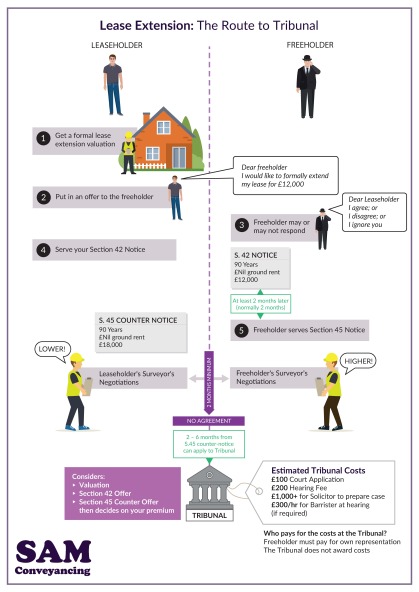
You can negotiate at two distinct points during the process: informally before any legal notices are served, and formally after the freeholder responds to your legal claim with a counter-offer.
To ensure you have the upper hand in these negotiations, we can help. Get an online quote to see how we can save you money on your valuation costs, or arrange a free initial consultation with a member of our team:
Step 1: Get a RICS lease extension valuation
Never enter a negotiation blind. Most specialist RICS surveyors will calculate a "best-case" and "worst-case" scenario for what you should pay under the statutory Leasehold Reform Act formula.
Can you use an online calculator to negotiate?
No. Free online lease extension calculators only indicate a rough budget. Your freeholder will immediately reject a calculator estimate during negotiations because it lacks professional credibility.
A freeholder's surveyor will demand to see a qualified RICS valuation that accurately factors in the term rate, the reversionary rate, and local property relativity. If you try to negotiate without one, you will inevitably have to pause the process and pay for a proper survey anyway.
Step 2: Make an informal offer (Template Included)
If you have a direct relationship with your freeholder, you can attempt to negotiate informally before incurring heavy legal fees. Inform them of your intention to extend and state your opening offer based on your RICS valuation.
- The Best Outcome: They agree to a fair premium, and you move straight to conveyancing.
- The Worst Outcome: They ignore you or demand an inflated price, at which point you simply proceed to the formal statutory route.
Not sure how to start the conversation? Download our free template letter to kick off negotiations with your landlord.
Step 3: Serve the Section 42 Notice
If informal negotiations fail (or if your freeholder is a large management company or local council that refuses informal offers), your solicitor will serve a statutory Section 42 Notice. This legally compels the freeholder to grant the extension.
You must include a proposed premium in this notice. The best strategy is to put forward a reasonable offer just below the middle ground of your surveyor's "best and worst-case" valuation bracket. Starting too low can antagonise the freeholder and guarantee a hostile counter-notice, while starting too high wastes your own money.
Step 4: Handle the Section 45 Counter-Notice
Your freeholder has two months to respond with a Section 45 Counter-Notice. Unless they accept your initial offer, this notice will outline their proposed (and usually much higher) counter-premium.
Can a freeholder refuse to negotiate?
No. Under the Leasehold Reform, Housing & Urban Development Act 1993, a qualifying leaseholder has a legal right to a lease extension. A freeholder cannot simply refuse to grant it, nor can they refuse to serve a Counter-Notice. If they fail to respond entirely, your solicitor can apply to the county court for a Vesting Order, which forces the extension through on your original terms.
Step 5: Instruct your surveyor to negotiate
Once the Counter-Notice is received, the formal negotiation phase begins. This is not handled by your solicitor, but directly between your RICS surveyor and the freeholder's surveyor.
- Accept the Counter-Offer: If the freeholder's premium is very close to your surveyor's valuation, it is often cheaper to simply accept it rather than paying your surveyor hourly fees to argue over a few hundred pounds.
- Surveyor Negotiation: If the gap is significant, your surveyor will challenge the freeholder's valuation data. Surveyors typically charge between £150 and £300 per hour for negotiation. Always weigh the cost-benefit: spending £1,000 on negotiation fees to reduce the premium by £1,200 is rarely worth the time and stress.
- Proceed to Tribunal: If the two surveyors cannot reach an agreement within the statutory timeframe, your solicitor can escalate the dispute to the First-tier Tribunal (Property Chamber). The Tribunal will review the evidence and legally impose a final premium. Because Tribunal costs are unrecoverable, this is always treated as a last resort.

Andrew Boast FMAAT is a qualified accountant, conveyancing specialist and author with over 25 years of experience in the UK property sector. Since beginning his career in 2000 within established SRA and CLC-regulated conveyancing solicitor firms, Andrew has overseen the legal journeys of more than 75,000 clients.
He is the self-published author of the first-time buyer guide: How to Buy a House Without Killing Anyone, and a frequent contributor to mainstream UK media on legislative updates, property law, first-time buyer guides, conveyancing best practices, and stamp duty changes. Andrew specialises in resolving complex title issues, property conflict disputes, and property tax options, streamlining the enquiry process to reduce transaction times and maintaining a client-friendly focus.

Amanda Ambler is a highly accomplished conveyancing specialist with over 15 years of dedicated experience across residential property law, legal compliance, and practice management. Having held senior roles, including Head of Legal Practice and Head of Conveyancing at established UK law firms, Amanda possesses a profound, hands-on understanding of the technical intricacies of the property market.
As the designated Legal Content Reviewer for SAM Conveyancing, Amanda ensures that every guide, legal update, and resource published meets the absolute highest standards of accuracy, regulatory compliance, and factual integrity. Her rigorous review process guarantees that complex property legislation and industry processes are communicated clearly, transparently, and safely for home buyers and sellers alike.
Latest Leasehold Tips & Guides

The Informal (Non-Statutory) Lease Extension Process



What are the Freeholder's Reasonable Costs? (Section 60)






What is a Retention When Buying a Leasehold Property?

Ground Rent: Complete Guide to Leaseholder Costs and Rights


What Are Apportionments When Buying a Leasehold Property?