Bank Undervalued Property: What You Can Do

A down valuation occurs when a lender’s surveyor values a property at a lower amount than the price you have agreed to pay. This creates an immediate hurdle: the bank will only lend based on its lower figure, leaving you with a financial gap to bridge.
For the buyer, this can feel devastating, as they were happy to pay what they offered; however, the bank's mortgage valuation considers it too high.
This isn't the end of the road, though, and this guide will help you challenge the lender's valuer and, if that fails, negotiate a property price, because no buyer should pay more than the property is worth. Plus, you never know when a cheeky offer back to the seller may be accepted, allowing the purchase to complete.
How do mortgage lenders value property?
Mortgage lenders do not value a home based on what you are willing to pay; they value it based on the risk to their investment. To finalise a mortgage offer, the lender instructs an RICS-registered valuer to provide a report in accordance with the RICS Red Book Global Standards.
The valuer primarily looks for market value through:
Recent comparables:
They look for at least three similar properties within a small radius that have sold (not just listed) in the last six months.Property condition:
If major defects like damp or subsidence are visible, the valuer will reduce the valuation to reflect the cost of repairs.
The safety net:
If direct comparables are missing, they follow a strict hierarchy of evidence to adjust prices from nearby areas or older data.
Why do banks undervalue property?
Mortgage Lenders are cautious by nature; they need to ensure the property provides sufficient security for the loan in case they ever have to sell it to repay the mortgage. When a bank undervalues a property, it is not necessarily an issue with the property's condition.
Lack of comparables
If the surveyor finds a lack of comparable sales data in the local area, they will adopt a more conservative valuation of the property using the RICS hierarchy of evidence process.
Slowing/cooling market
If the surveyor suspects the market is cooling, they may provide a conservative valuation. This could be a localised slowdown, a national influence such as a budget or a general election, or a global issue such as the 2020 COVID-19 outbreak, the 2022 Ukraine War, or the 2026 Iran War.
Building materials
Non-standard construction can significantly complicate a mortgage valuation because lenders view these properties as higher risk. If a building isn't made of traditional brick and mortar or stone with a slate or tile roof, it falls into the non-standard category.
Poor condition
If the surveyor spots an issue with the property, they will normally downvalue it and instruct the lender not to issue a mortgage offer without a specialist report. The main issues are:
- Subsidence: The property is showing signs of movement and needs a building surveyor or structural engineer to confirm if there is continual movement (subsidence).
- Damp: The property is showing signs of damp and needs a specialist damp surveyor to confirm how water is entering the property.
- Structural issue: The property has had a load-bearing wall removed, or the roof is in poor condition. The lender will need a report on the implications of this from a structural engineer.
Expert Tip: Non-standard construction mortgage valuations
Under RICS Red Book guidelines, a valuer must identify these materials and assess their long-term durability and saleability. Non-standard materials include:
- Concrete construction (pre-cast & in-situ): Most lenders will only provide a mortgage offer if the property has been repaired under a licensed scheme (e.g. PRC Homes Ltd) and carries a PRC Certificate.
- Timber Frame Construction: A surveyor will check for adequate "breathability" and weatherproofing.
- Steel Frame Construction: Lenders often require a structural engineer's report to finalise the value. If the steel is encased in concrete or asbestos-containing materials, the valuation may be significantly downgraded to reflect the cost of future remediation.
It is vital to check the construction type before paying for a mortgage valuation. If a surveyor identifies an unrepaired pre-cast concrete frame, the valuation will likely be £0 (unmortgageable) until specialist repairs are completed.
CEO of SAM Conveyancing
How to dispute a mortgage lender's valuation?
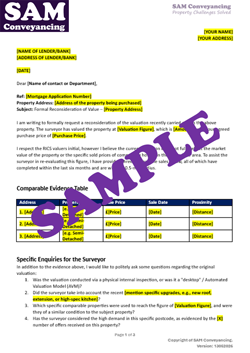
Disputing a mortgage lender's valuation, often called a "reconsideration of value", is the process of officially challenging a surveyor's assessment when it falls below your agreed purchase price. While a down valuation can feel like a roadblock, it is a formal part of the lending process that can be challenged if you can provide factual evidence that the surveyor has missed key market data.
If you believe your property has been undervalued, you cannot simply argue that you feel it is worth more. You must follow a structured evidentiary path:
Request the valuation report:
Ask your lender or broker for the specific figures and the valuation basis. Some lenders provide only a summary, while others provide the full report.
Gather "comps" (comparables):
You generally need 2 to 3 examples of similar properties within a 0.5 to 1-mile radius that have sold (not just been listed) in the last six months. Read my expert tip: What happens when there are no comparables?
Check for factual errors:
Look for mistakes in the report regarding the number of bedrooms, square footage, or the tenure (e.g. listing it as leasehold when it is freehold).
Submit the formal appeal:
Your mortgage broker will usually submit a specific Valuation Appeal Form to the lender on your behalf, attaching your evidence and a covering letter.
Is the process the same across all lenders?
No. While the need for comparable evidence using the RICS Red Book method is universal, the eligibility criteria and timelines for an appeal vary significantly between UK mortgage lenders:
- Threshold requirements: Some lenders, such as HSBC and Accord Mortgages, will only accept an appeal if the discrepancy is significant (e.g. the valuation is at least 15% lower than the expected price).
- Strict timelines: Nationwide requires appeals to be lodged within 10 working days of the valuation being shared. Miss this window, and the decision is usually final.
- Submission limits: Most lenders allow only one appeal per application. If the surveyor stands by their original figure after reviewing your evidence, you cannot appeal again with the same lender.
- AVM vs. physical: If your bank used an Automated Valuation Model (AVM), you may be able to dispute it simply by requesting a physical inspection, though some lenders (like HSBC) only allow this if the property has had significant structural changes. The good news is that this does work; read our case study.
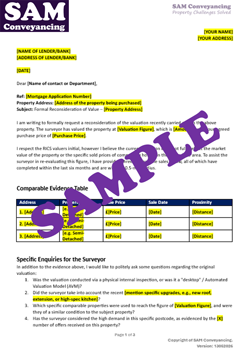
Download a template letter to dispute the valuation with your mortgage lender today.
- Includes a table for comparison of property sold prices.
- Written to keep disputes professional.
- Tried and tested format.
- Easy to fill in.
Expert Tip: What happens when there are no comparables?
Where there are no recently sold properties to compare to the one you're buying, then the surveyor must use the hierarchy of evidence to prove why they undervalued the property. This is where the RICS surveyors' opinion comes into play, and you may be able to provide better evidence to support your offer price.
- Widen the search: Find properties in the local area that share the exact style, condition and make of your property
- Recently sold but older than 12 months: If you can only find local sold properties that are over 12 months old, then use the House Price Index (HPI) to adjust those figures for inflation or market growth(i) .
- No semi-detached, then compare to detached: If a semi-detached house hasn't sold recently but a detached one has, then provide comparables for a detached property the same size and condition as yours and apply a "weighted deduction" of around 10-15% to estimate the semi-detached value.
(i) Not all areas of the UK grow at the same rate, so include local market variations as well as national changes.
The final check
Once you have your comparable properties, you need to do the final sanity check comparing the internal floor area against broader regional averages to ensure the price is realistic. Log all this data in a spreadsheet, along with your supporting links/documents. This is the evidence you need to appeal an undervalued mortgage valuation.
CEO of SAM Conveyancing
What if the lender won't upgrade their valuation?
If the lender changes their down valuation, then you will receive a new mortgage offer, and the conveyancing process can be finalised. If, however, the lender doesn't change their position, you have to weigh up whether to proceed with the purchase.
Negotiation with the seller
This is the best option for any buyer. You should first negotiate with the seller. An undervalued property will disrupt your seller's plans, potentially affecting their onward purchase. It might mean they're now under budget for their next home and stuck on what to do next, leading to your offer falling through as well.
The banks' undervaluation of the seller's property is a problem for both the seller and buyer to overcome, and it is often something you can't ignore because a future buyer may encounter the same issue. The options are:
- The seller accepts a reduced offer in line with the lender's down valuation.
- The seller and buyer "split the difference" and meet in the middle. The buyer will need to be able to afford this (see below).
If negotiations are unsuccessful, the buyer can pull out and buy another property. This shouldn't be seen as a "card to play" it is merely the reality that a bank has undervalued the property and could mean the buyer is buying a property that isn't worth what they are paying for it. Before this is considered, the seller and buyer should add up the costs incurred to date, the time spent, and the time and costs to find a new property/buyer - is there a middle ground to be found?
Do you need to negotiate your house price?
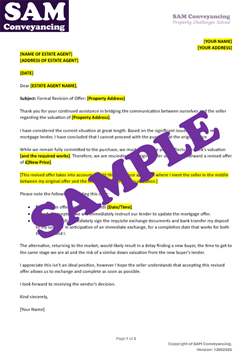
- Suitable for negotiating offers with the seller post home buyer survey, or a down-valued mortgage valuation.
- Instant download.
- Easy to fill in.
Proceed and make up the difference
If you have the funds, you can cover the shortfall yourself. This keeps the mortgage amount within the lender's required Loan-to-Value (LTV) ratio based on their lower valuation. This is a high-risk decision because you are ignoring a professional RICS valuer's assessment of the property's value and paying a premium for the property.
If the lender agrees to lend the lower amount and you can make up the difference, then you can proceed with the purchase, but at what cost?
- You make the difference between your original deposit and the lender's reduced lending for the Loan to Value.
- You pay more in Stamp Duty Land Tax.
- When you remortgage, the property may not be suitable security for the mortgage amount you need.
- As of day 1, if you sold the property on the open market, it would be worth less to another buyer.
Expert Tip: Keep it professional
I get that moving home is highly stressful; however, losing your temper at the mortgage lender or questioning the competence of the RICS valuer isn't going to change their opinion. Only professionally presented facts will.
RICS surveyors may not like your approach to question their professional opinion on the valuation, so if you don't want to get their back up, use phrases like, "I am sure you've considered this, however, did you spot this property?", or "Did you spot in your valuation that you state the property is leasehold, when it is a freehold?". The valuer will be more inclined to review their position if the request is balanced and professional.
You can ignore this and go in full guns blazing; however, be prepared. If the surveyor takes offence to the challenge and refuses to engage, it means you must pay for a new valuation, or make a new mortgage application with a new lender.
CEO of SAM Conveyancing
Summary: What to do if your mortgage valuation has been downvalued
We've covered a lot above, so here is a checklist to ensure you don't pay a penny more than what the property is worth.
- Review the report: Obtain the mortgage valuation from the letter and see why the property has been undervalued.
- Gather comparables: Collate your evidence to prove that the lender is wrong. Identify three similar local sales from the last six months.
- Raise a dispute: Provide your evidence to the mortgage and keep it calm and professional.
- Speak to the seller: Open a dialogue about a price reduction as soon as the shortfall is confirmed. Make this a joint problem, and find a solution together.
- Check LTV impact: Assess if the lower valuation changes your mortgage interest rate.
- Choose a new lender: A new lender, new valuer, can often bring about a new valuation. You'd be surprised how many valuations come in at the offer price when you change lenders.
- Be led by your head, not your heart: A RICS valuer is far more experienced than you, so why pay more for something they don't think is worth it.
- Is it worth it? Assess if all the agro is worth it, considering this could happen again when you come to sell.
Frequently Asked Questions When Bank Undervalues a Property

Andrew Boast FMAAT is a qualified accountant, conveyancing specialist and author with over 25 years of experience in the UK property sector. Since beginning his career in 2000 within established SRA and CLC-regulated conveyancing solicitor firms, Andrew has overseen the legal journeys of more than 75,000 clients.
He is the self-published author of the first-time buyer guide: How to Buy a House Without Killing Anyone, and a frequent contributor to mainstream UK media on legislative updates, property law, first-time buyer guides, conveyancing best practices, and stamp duty changes. Andrew specialises in resolving complex title issues, property conflict disputes, and property tax options, streamlining the enquiry process to reduce transaction times and maintaining a client-friendly focus.

Amanda Ambler is a highly accomplished conveyancing specialist with over 15 years of dedicated experience across residential property law, legal compliance, and practice management. Having held senior roles, including Head of Legal Practice and Head of Conveyancing at established UK law firms, Amanda possesses a profound, hands-on understanding of the technical intricacies of the property market.
As the designated Legal Content Reviewer for SAM Conveyancing, Amanda ensures that every guide, legal update, and resource published meets the absolute highest standards of accuracy, regulatory compliance, and factual integrity. Her rigorous review process guarantees that complex property legislation and industry processes are communicated clearly, transparently, and safely for home buyers and sellers alike.