
Buying a New Build: Top Tips

Buying a new build home offers the distinct advantage of a chain-free move, modern energy efficiency, and a property that acts as a complete blank canvas. However, purchasing directly from a developer, often off-plan, presents unique practical challenges that differ significantly from buying an already registered property.
To ensure you protect your investment, this guide outlines the essential top tips for buying a new build, covering everything from negotiating fixtures and scrutinising the show home, to understanding when to commission an independent snagging survey before you finalise the purchase.
What to check before reserving your home
One of the most critical differences between buying a new build and a normal property is that you must pay a reservation deposit of between £250 and £2,000 to secure the plot and take it off the market. However, signing the reservation agreement instantly starts a strict countdown, usually giving you just 28 days to exchange contracts. Before you commit your money and start the clock, you must thoroughly scrutinise the developer, the specific plot, and the terms of the agreement.
Developer credentials and protection codes
Do not rely solely on the glossy marketing brochures. According to official figures from The Insolvency Service, the UK construction sector consistently experiences the highest number of business failures of any industry, with 3,803 construction firms becoming insolvent in the 12 months to May 2026. If a developer goes into administration mid-build, your deposit and the completion of your home are at significant risk.
To protect yourself, check if the developer is registered with the New Homes Quality Board (NHQB) or adheres to the Consumer Code for Home Builders. These independent regulatory frameworks mandate how your deposit must be protected if the firm ceases trading. Furthermore, review their Home Builders Federation (HBF) star rating, and search Companies House to review their most recent financial accounts before paying a reservation fee.
Plot location and site nuances
The developer’s show home is strategically positioned and designed to look perfect, but your actual plot will differ. You need to review the master site plan with a critical eye:
- Orientation: Check the site compass to determine which way your garden faces (south-facing gardens receive the most sunlight).
- Surroundings: Look at the proximity to main roads, streetlights, and commercial units. Listen as well at various times of day, especially during school drop-off and collection.
- Future development: Ask to see the long-term master plan. You need to know if the quiet field opposite your plot is earmarked for 'Phase 2', which could mean living next to a construction site for the next three years.
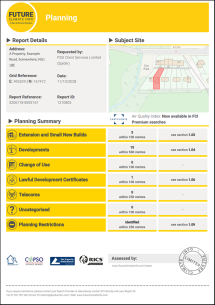
You can download a Planning Report from us today for £72 INC VAT and see what planning is in the pipeline around your new home. Download Planning Report.
Specifications vs optional extras
Show homes are almost always fitted with premium upgrades that do not come standard. Before reserving, demand a comprehensive, itemised list of what is actually included in the base price. You must clarify whether essential items such as turf, garden fencing, white goods, and flooring are standard inclusions or expensive optional extras.
Reservation fee refund terms
If your circumstances change or your mortgage falls through before exchange, you may need to pull out. Under the New Homes Quality Code, you are entitled to a refund of your reservation fee; however, the developer may deduct reasonable administrative expenses incurred. Before you sign, ask them to provide a written breakdown of exactly what those administrative deductions would be so there are no surprises.
Order a search and find out what has been approved, rejected or carried out in the last 10 years.
- Includes planning applications for extensions on your property and on your neighbour's property within 100 metres, developments within 500 metres, properties that have had a change of use, awful development certificates, as well as telecoms and planning restrictions.
- Report delivered within 2 working hours (during working hours).
- Fixed fee of £72 INC VAT.
Essential questions for the developer
The developer hires highly trained sales teams to focus on the lifestyle benefits and cosmetic finishes of a new build. To protect your investment, you need to look past the show home and uncover the financial and structural realities of the specific plot you are buying.
Asking these targeted questions early prevents expensive surprises and delays once your solicitor begins the legal work.
Are the roads and shared areas being adopted by the council?
Local authorities increasingly refuse to adopt the roads, pavements, and communal green spaces on new build estates. If the developer does not have a formal 'Section 38 agreement' with the council for adoption, a private management company will be appointed to maintain the infrastructure. Every household on the estate will be legally obligated to pay an annual estate management charge. You must ask for the estimated annual cost, a breakdown of what it covers, and crucially, whether the contract includes a cap on future increases.
What restrictive covenants are attached to the freehold?
Even if you are buying a freehold house, developers routinely place covenants on the land title to maintain a uniform aesthetic across the estate. You must ask for a list of these restrictive covenants before reserving. Common covenants include strict bans on parking commercial vans or caravans on your own driveway, prohibitions against erecting sheds or conservatories, and even rules preventing you from changing the colour of your front door or putting up a satellite dish.
Does your freehold have an estate management company?
To keep local authority costs down and to make planning permission easier to secure, developers often retain private control over the development's communal spaces. They pass the maintenance costs onto the new build properties through estate management fees (legally known as estate rentcharges). This is both an additional cost burden and a legal hurdle that can make selling a freehold as complex as selling a leasehold. Every time you remortgage or come to sell, you will need to pay for an estate management pack to confirm to the buyer's solicitor that your account is up to date.
What financial commission do you receive for solicitor referrals?
Developers often pressure buyers to use their recommended panel of conveyancing solicitors or mortgage brokers, sometimes offering free carpets or upgraded appliances if you agree. Under the updated New Homes Quality Code Version 2 (For homes reserved from 2 March 2026), developers are strictly prohibited from using high-pressure sales tactics and must disclose to you in writing the exact nature and expected amount of any financial commission they receive for referring you. You are always completely free to instruct your own independent legal representation.
If the developer leaves the pressure to the selling agent, then they too could be breaching their code of conduct under the Property Ombudsman. An estate agent is in breach by "Pressuring a potential buyer to use associated services, for example to take out a mortgage through the in-house mortgage advisor or to use a particular firm of solicitors or licensed conveyancers".
Can I see the guaranteed dimensions in accordance with RICS measurement standards?
Marketing brochures can use deceptive camera angles or scaled-down furniture to make rooms look larger than they are. The March 2026 NHQB updates explicitly ban 'drip pricing' and mandate that developers must provide the size of each room and the total home calculated on a gross internal area basis, strictly following the RICS Code of Measuring Practice. Demand these exact figures rather than relying on the floorplan illustrations.
However, you must be aware of the construction 'leeway'. Developer contracts legally build in a construction tolerance typically +/- 50mm per room, or up to a 5% variance on the total floor area. If the final built property shrinks beyond this acceptable tolerance, it is classed as a 'significant change' under the New Homes Quality Code, giving you the legal right to withdraw from the purchase and receive a full refund of your reservation fee and deposit.
Expert Tip: Verify the developer via the Responsible Actors Scheme
If you are buying a new build flat in a mid-to-high-rise block, you must check the Government’s Responsible Actors Scheme (RAS) register. Following the introduction of the Building Safety Act in July 2023, major developers were required to sign a remediation contract for their historic buildings (pre-2022) in order to join the scheme.
If your developer was eligible but refused to sign, or has been removed from the RAS, the Government can legally block them from receiving building control approval or carrying out major new developments. Checking this register ensures you are buying from a developer legally permitted to actually finish your building, and one that has proven they will take financial responsibility for structural safety.
CEO of SAM Conveyancing
Understanding new build mortgages
Securing a mortgage for a new build property is fundamentally different from buying an older home, especially for a first-time buyer. The developer’s construction timeline dictates the process, and lenders apply much stricter criteria to newly built homes to protect themselves against initial depreciation.
Getting your mortgage strategy wrong at the start is the most common reason first-time buyers lose their reservation fees.
Mortgage offer validity and build delays
A standard high-street mortgage offer is typically valid for three to six months. If you are purchasing off-plan, the property might not be physically finished for 12 to 18 months, and it is almost always delayed beyond the estimated completion date. If your mortgage offer expires before the build is complete, you will have to reapply, risking higher interest rates or a total rejection if lending criteria have tightened. As a first-time buyer, you must use a mortgage broker to identify a specialist new build lender that offers an extended 9 to 12-month offer validity.
Read more: How long does a mortgage offer last for? and Can a mortgage offer be withdrawn?
First-time buyer schemes and deposit limits
While you may only need a 5% deposit for an older property or a new build house, lenders often view new build flats as a higher risk. Many lenders cap the maximum Loan-to-Value (LTV) at 85% for new build apartments, meaning you could unexpectedly need a 15% cash deposit. To overcome high deposit barriers, actively seek out developments that participate in the government's First Homes Scheme. Available in England, this scheme offers eligible first-time buyers a permanent discount of 30% to 50% off the open-market value on selected new-build homes.
The hidden trap of developer incentives
Sales teams frequently offer first-time buyers tempting incentives to reserve a plot quickly, such as £5,000 cashback, free premium flooring, or paying your solicitor fees. However, mortgage lenders require you to declare all financial incentives. Crucially, most lenders will deduct the cash value of these incentives from the purchase price when calculating your mortgage. This lowers your effective LTV ratio and often requires you to increase your upfront cash deposit to secure the loan.
Expert Tip: Securing a 12-month offer validity
Do not simply accept your bank's standard 6-month mortgage offer if you are buying off-plan. Several major UK lenders have completely overhauled their new build criteria to combat construction delays.
For example, Nationwide and Skipton Building Society now offer a 9-month validity period as standard on new build applications. Furthermore, NatWest currently offers an initial 6-month period but explicitly allows your broker to apply for two consecutive 3-month extensions, securing your mortgage funding for a full 12 months. Always instruct a specialist broker to target these lenders to protect your deposit if the build runs over schedule.
CEO of SAM Conveyancing
New Build Mortgages and 5% Deposits
New builds are considered higher risk by lenders because the property loses its 'new build premium' as soon as you move in, much like buying a brand-new car. Consequently, high-street lenders often cap their Loan-to-Value (LTV) at 85% for new builds, suddenly requiring you to find a 15% deposit.
To combat this, you must use an independent mortgage broker. A specialist broker can access exclusive new-build lender products and active 5% deposit routes. While the old Deposit Unlock Scheme closed in April 2026, brokers can now point you toward the government-backed Mortgage Guarantee Scheme or developer-specific incentives like Own New, allowing you to buy with just a 5% deposit.
- Panel of FCA-regulated mortgage brokers.
- Mortgages for First-time buyers, new builds, home movers and buy-to-lets.
- Support for employed, self-employed, or director mortgages.
- Access to the whole mortgage market.
- Friendly and professional mortgage advice.

Pros & cons of buying a new build
- Modern features and low maintenance
- Structural warranty protection (e.g., NHBC)
- No onward chain delays
- Energy efficiency and lower utility bills
- Access to government buying schemes
- Options for customisation (depending on the build stage)
- Zero ground rent on new leases (banned under the Ground Rent Act 2022)
- Developer incentives (e.g. paying for carpets or Stamp Duty)
- Higher initial purchase price (the 'new build premium')
- Stricter mortgage lending criteria and higher deposit requirements
- Non-refundable reservation fees if you pull out
- Risk of severe construction delays
- Snagging issues and cosmetic defects upon moving in
- Smaller room dimensions and limited outdoor space
- Lack of established neighbourhood character
- Highly variable after-sales care depending on the developer
- High estate management fees, even if you buy a freehold house
- Slower capital growth in the first few years as the 'brand new' premium fades
If you are buying a new build flat or maisonette, read up about the additional considerations involved in buying a leasehold property.
Negotiating with the developer
What you may not know is that you can negotiate with the developer. The success rate may be lower, and the win may not be a lower house price, but instead some extras thrown in. Here's how to negotiate:
Compare with existing properties on the market
Is your property listed for more than similar older properties nearby? If so, there may be room to haggle, especially if the property is already physically complete or nearing the end of the developer's financial year (often March/April). Use our house offer tool to average out the price per square meter in your area. This will help you make a winning offer.
Different developers offer different incentives to secure a quick reservation; they may offer to pay for your carpets or even pay your Stamp Duty. Beware: Any financial incentive that totals more than 5% of the property’s value must be declared and will likely cause your mortgage lender to reduce the amount they are willing to lend you.
Instruct your solicitor before you reserve
Your reservation fee is payable immediately upon acceptance of your offer. If you do not instruct a conveyancer until after you have paid this fee, you lose your negotiating power because you stand to lose the money if you pull out. Having your conveyancer ready beforehand ensures you can act immediately to protect your deposit.
With SAM Conveyancing, your purchase is protected by our No Sale No Fee Policy. If your new build purchase falls through due to severe developer delays, you won't have to pay your solicitor's basic legal fees for that specific transaction, and your initial legal deposit is simply carried over to your next property purchase.
- We can help with selling, buying, transfer of equity, and Help to Buy,
- Fixed and competitive quote.
- No Sale, No Fee Protection (Terms apply).
- Friendly and helpful service from start to finish.
- Over 55,000 completed cases since we opened in 2014.

Are you selling a property to buy this new build?
If you are selling your current home, you are at the top of a property chain. You must ensure the developer is aware of this from day one. New build timelines are notoriously rigid, and if the developer's schedule does not align with your buyer's timeline, the entire chain can collapse. Communication between your selling agent and the site office is critical.
Why you need a snagging survey
There is a common misconception that because a home is brand new, it will be flawless. In reality, industry data show that the average new-build property contains in excess of 140 defects (known as 'snags'). While many of these are minor cosmetic issues, such as scratched glass or uneven paintwork, others can be hidden and severe, such as poorly installed insulation, bridged damp proof courses, or leaking plumbing.
You cannot rely on a quick walk-through to spot these issues. Commissioning an independent snagging survey is the most effective way to hold the developer accountable for the quality they promised.
Your right to a Pre-Completion Inspection (PCI)
Historically, many developers refused to let buyers inspect the property until after they had paid the final balance and received the keys. However, under the updated New Homes Quality Code Version 2 (effective from March 2026), you now have the explicit legal right to conduct a Pre-Completion Inspection (PCI). This means you can hire an independent, RICS-qualified surveyor to thoroughly inspect the property before you legally complete the purchase. Identifying major defects at this stage gives you immense leverage to demand repairs before you hand over your money.
The two-year developer warranty period
Your new home will come with a 10-year structural warranty (such as NHBC Buildmark), but the cover is split. For the first two years, the developer is directly responsible for fixing all defects, including cosmetic snags. Submitting a professional snagging report immediately after you move in provides documented, photographic evidence of the home's condition. This prevents the developer from avoiding responsibility by claiming that you caused the scratches or damage while moving your furniture.
The 30-Day resolution rule
Having a professional surveyor draft your snagging list ensures the report is formatted to align perfectly with official developer protocols. Under the latest NHQB rules, once you submit this formal list, the developer is obligated to rectify the issues within 30 days wherever possible (with emergency issues resolved within hours). Booking your survey early ensures that the builders are often still on-site working on other phases, making it much easier and faster to get tradespeople back into your property to finish the job correctly.
Tips for after you move in
Don't decorate immediately
New build properties take between six and twelve months to fully dry out, during which time minor 'shrinkage cracks' will naturally appear in the plasterwork as the building settles. Hold off on wallpapering or heavy redecorating until this drying-out phase is complete to avoid having to touch up cracks later.
Register your address with Royal Mail
Your new home needs to be officially registered on the Royal Mail database so you can receive post, order deliveries, and take out home insurance. You should check with your developer if they have initiated the postal registration. If your house doesn't show up online, contact Royal Mail directly.
Check your Council Tax Band
Council tax bands on new estates are often predicted before the properties are finished. Once you move in, you should verify with the local Valuation Office Agency (VOA) that you have been placed in the correct band relative to the final size of your home.
Frequently Asked Questions About New Build Tips

Andrew Boast FMAAT is a qualified accountant, conveyancing specialist and author with over 25 years of experience in the UK property sector. Since beginning his career in 2000 within established SRA and CLC-regulated conveyancing solicitor firms, Andrew has overseen the legal journeys of more than 75,000 clients.
He is the self-published author of the first-time buyer guide: How to Buy a House Without Killing Anyone, and a frequent contributor to mainstream UK media on legislative updates, property law, first-time buyer guides, conveyancing best practices, and stamp duty changes. Andrew specialises in resolving complex title issues, property conflict disputes, and property tax options, streamlining the enquiry process to reduce transaction times and maintaining a client-friendly focus.

Amanda Ambler is a highly accomplished conveyancing specialist with over 15 years of dedicated experience across residential property law, legal compliance, and practice management. Having held senior roles, including Head of Legal Practice and Head of Conveyancing at established UK law firms, Amanda possesses a profound, hands-on understanding of the technical intricacies of the property market.
As the designated Legal Content Reviewer for SAM Conveyancing, Amanda ensures that every guide, legal update, and resource published meets the absolute highest standards of accuracy, regulatory compliance, and factual integrity. Her rigorous review process guarantees that complex property legislation and industry processes are communicated clearly, transparently, and safely for home buyers and sellers alike.