DIY Conveyancing: Can You Do Your Own Conveyancing?

When clients ask, "Can I do my own conveyancing?" they are usually looking at the transaction from a very simplistic angle: transferring money to buy a property. Surely it is that simple? Sadly, it is not.
Due to complex title restrictions, easements, leaseholder requirements, mortgage lender conditions, and strict anti-money laundering regulations, HM Land Registry will not allow the vast majority of conveyancing transactions to be completed without the work being handled by a regulated solicitor or licensed conveyancer.
There are a handful of very specific conveyancing services you can technically do yourself. However, even on those rare occasions, HM Land Registry will still expect you to hire a professional solicitor to formally verify your identity using an ID1 form to prevent property fraud.
In this guide, we explain exactly why HM Land Registry restricts DIY transactions, expose the severe resale risks that could render your home virtually worthless, and share expert tips on how to keep your legal fees as low as possible when instructing a professional.
- You can technically do your own conveyancing (DIY conveyancing) if it is a cash transaction without a mortgage.
- However, undertaking the legal transfer yourself carries severe financial and legal risks.
- For almost all sales, purchases, transfers of equity, and remortgages, you will need to instruct a qualified conveyancer or solicitor.
- Even in scenarios where a solicitor is not strictly required, the legal protection and efficiency they provide far outweigh the cost of their fees.
What is conveyancing?
Conveyancing is the legal transfer of a property from one owner to another. The process normally begins when you instruct your conveyancing solicitor - either just after your offer has been accepted as a buyer, or when you have accepted an offer as a seller.
Conveyancing also refers to the legal administration required for a transfer of equity (when adding or removing someone from the title deeds) and when remortgaging from one lender to another.
There is a multi-part legal process that must be carried out before you can safely get the keys to your new home. The conveyancing journey only concludes when you have paid for the property, settled any Stamp Duty liability, and successfully registered the new ownership with HM Land Registry.
Can an individual do their own conveyancing?
Yes, you can do your own conveyancing (often referred to as DIY conveyancing) if it is a cash transaction without a mortgage. However, this is only possible if the other party does not have a solicitor who flatly refuses to deal with an unrepresented individual.
Despite being legally permissible in strict circumstances, DIY conveyancing is highly advised against due to the sheer number of risks involved. You will almost certainly increase the transaction time, and a single administrative mistake can lead to devastating financial consequences.
The massive risks of DIY conveyancing
If you are considering using a "DIY conveyancing kit" to save money on legal fees, you must understand the severe caveats involved:
- Lack of Professional Protection: A mistake can be incredibly costly. Property lawyers are protected by Professional Indemnity Insurance, which pays out if their error costs you money. If you make a mistake doing it yourself, you carry 100% of the financial liability.
- Client Accounts and Anti-Money Laundering: Conveyancing solicitors hold money securely in regulated client accounts and carry out stringent Anti-Money Laundering (AML) checks. The other party's solicitor will likely refuse to accept hundreds of thousands of pounds directly from your personal bank account.
- Inability to give Undertakings: An "undertaking" is a solicitor's legally binding promise to carry out a specific task. Failure to comply results in severe disciplinary action by the SRA. Because you are a private individual, you cannot give a legally reliable undertaking, making you a high-risk liability to the other party.
- Contractual Errors: Solicitors use standardised, legally watertight documents, including complex legal enquiries and contracts of sale. Drafting these yourself without legal training is stressful, time-consuming, and leaves you open to significant legal loopholes.
- Refusal to Cooperate: Because of the risks outlined above, the other party's solicitor may simply refuse to proceed with the transaction if you are representing yourself.
Expert Tip: Lenders will not allow DIY conveyancing
If you are buying a home with a mortgage or selling a home that still has an active mortgage attached to it, DIY conveyancing is entirely off the table. Your bank or building society will absolutely insist that a regulated solicitor or licensed conveyancer is instructed to protect their financial charge over the property.
CEO of SAM Conveyancing
How long does the conveyancing process take?
The conveyancing timeline will vary depending on whether the property is freehold, leasehold, or purchased through a shared ownership scheme.
The timeline can easily slide due to several potential delays: structural defects discovered in a property survey requiring renegotiation, the other party lacking the correct paperwork, breaks in the property chain, local authority delays in returning searches, or a change in financial circumstances affecting mortgage approval.
Freehold: 8 to 10 weeks
If it is a freehold transaction with no chain complications, the standard process takes around 8 to 10 weeks.
Leasehold: 10 to 12 weeks
If it is a leasehold, conveyancing will typically take between 10 and 12 weeks. The process is longer because your solicitor must manage significantly more complicated legal work and liaise with a third-party freeholder or management company.
Shared ownership: 10 to 12 weeks
The shared ownership scheme also carries a lengthy conveyancing process of 10 to 12 weeks, largely due to the additional administrative step of agreeing the lease purchase agreement with the housing association.
Conveyancing can be completed much faster if there is no mortgage work required, no Capital Gains Tax or Stamp Duty to consider, or in cases where no money changes hands (such as a simple transfer of equity). Property auctions also have heavily fast-tracked processes, usually set at a strict 28-day completion deadline.
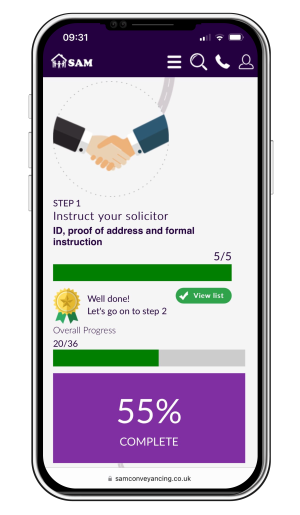
Our conveyancing process area includes:
- online checklists
- videos
- free downloads
- useful tips
It is completely free to use - from start to finish - and saves your progress along the way.
Bonus: Get a FREE book: House to Buy a House without Killing Anyone (Value £9.99).
How much does conveyancing cost?
If you decide to hire a professional, conveyancing costs will differ from firm to firm. Some solicitors estimate fees and charge by the hour, while others (like SAM Conveyancing) offer a transparent, fixed-fee structure. Depending on the complexity of the transaction, you can expect basic legal fees to range anywhere between £500 and £2,000.
Typically, you will pay higher legal fees for a leasehold transaction than for a freehold due to the extra third-party liaison required. Buying a property with a mortgage will also slightly increase the costs due to the extra legal work required to secure the lender's charge.
Why is the conveyancing process so complicated?
The conveyancing process can feel daunting. Given the numerous moving parts, the involvement of multiple professionals, and the substantial financial commitment, it is understandable why purchasing a property can be a stressful experience.
Here is exactly why the process is so highly regulated and complex:
- High Financial Stakes: For most people, buying a property is the most expensive purchase they will ever make. Strict legal protocols exist to ensure the property is legally sound and fit for purpose. If you are the seller, complex checks are required to ensure the buyer has legitimate, non-fraudulent funds to purchase your home.
- Coordination of Multiple Professionals: A lawyer handles the legal title transfer. If it is a leasehold, the freeholder must be involved. As a buyer, you will need a RICS surveyor to inspect the property for hidden structural defects. If you are buying with a mortgage, the lender will instruct their own valuer. All of these accredited professionals must communicate and align their findings before contracts can be exchanged.
- Complex Legal Administration: Investigating historical title deeds, drafting watertight contracts, safely transferring hundreds of thousands of pounds, and checking local authority planning permissions are just a few of the tasks a solicitor must manage. They need sufficient time to gather this documentation and identify any hidden legal risks that could affect your ownership rights.
- Fixed, competitive legal fees with no hidden costs.
- Expert conveyancing solicitors with proven local knowledge.
- No Sale, No Fee protection for your transaction. Terms apply.
- On 99% of mortgage lender panels.
- Fast completions.
- We can solve any property challenge.

Frequently Asked Questions

Andrew Boast FMAAT is a qualified accountant, conveyancing specialist and author with over 25 years of experience in the UK property sector. Since beginning his career in 2000 within established SRA and CLC-regulated conveyancing solicitor firms, Andrew has overseen the legal journeys of more than 75,000 clients.
He is the self-published author of the first-time buyer guide: How to Buy a House Without Killing Anyone, and a frequent contributor to mainstream UK media on legislative updates, property law, first-time buyer guides, conveyancing best practices, and stamp duty changes. Andrew specialises in resolving complex title issues, property conflict disputes, and property tax options, streamlining the enquiry process to reduce transaction times and maintaining a client-friendly focus.

Amanda Ambler is a highly accomplished conveyancing specialist with over 15 years of dedicated experience across residential property law, legal compliance, and practice management. Having held senior roles, including Head of Legal Practice and Head of Conveyancing at established UK law firms, Amanda possesses a profound, hands-on understanding of the technical intricacies of the property market.
As the designated Legal Content Reviewer for SAM Conveyancing, Amanda ensures that every guide, legal update, and resource published meets the absolute highest standards of accuracy, regulatory compliance, and factual integrity. Her rigorous review process guarantees that complex property legislation and industry processes are communicated clearly, transparently, and safely for home buyers and sellers alike.