Nightmare Neighbour? How to Legally Stop Disruptive Building Work

When a neighbour's dream home extension turns into your living nightmare, dealing with disruptive building work can take a devastating emotional and financial toll. Constant drilling, cracks snaking up your walls, and unpermitted skips blocking your driveway can make you feel completely powerless in your own home.
Fortunately, you do not have to simply grin and bear it. While standard building disruption is a part of life, the law draws a firm line between reasonable progress and actionable distress. By leveraging specific UK property and environmental laws, you can wield five legal shields to protect your home, your equity, and your peace of mind.
When does construction become a property dispute?
A formal property dispute doesn't start just because you hate the noise. It starts when a project next door crosses a strict legal boundary. Whether it is a loft conversion, a rear extension, or a new garden wall, serious neighbour disputes arise the moment that construction unlawfully infringes your property rights, breaches environmental laws, or compromises your home's structural safety.
While property owners have a right to improve their homes, that right ends the moment their builders commit civil trespass, cause structural damage, or cross the line into an actionable property dispute.
Meet the regulators and laws on your side
There are several regulators and laws that you should know about if you are unhappy with ongoing neighbour building work. These statutory regulations are designed to protect your home and provide a clear framework for resolving complex property disputes.
The two most critical frameworks you can leverage right now are:
- The Environmental Protection Act 1990: Your shield against unreasonable noise, dust, and vibrations caused by disruptive building work.
- The Party Wall etc. Act 1996: Your protection against a party wall dispute, structural excavations and boundary changes.
The Environmental Protection Act 1990 (EPA) is your strongest weapon against intrusive local construction. Under Section 79 of the Act, any dust, steam, or noise (including heavy vibrations) emitted from premises that are "prejudicial to health or a nuisance" qualifies as a statutory nuisance.
What's more is that the law strictly obligates your local authority to step in:
It shall be the duty of every local authority where a complaint of a statutory nuisance is made to it by a person living within its area, to take such steps as are reasonably practicable to investigate the complaint.
Source: Section 79(1), Environmental Protection Act 1990
What this means for you:
Your local council cannot simply ignore you. They have a legally binding, strict duty to investigate your report and, if a nuisance is found, issue an Abatement Notice to halt or restrict the disruptive building work.
The Party Wall etc. Act 1996 is your protection against structural excavations and boundary changes. It is your biggest tool for dealing with a party wall dispute. Under Section 6 of the Act, you must be notified of any structural excavations within 3 to 6 meters of your property line.
According to UK government planning portals, failing to comply with these statutory frameworks allows affected neighbours to seek immediate High Court injunctions to stop the build, transforming a minor disagreement into a major property dispute with all legal costs pushed back onto the developer.
Also, the law strictly obligates the building owner to give formal notice well in advance:
"Where a building owner proposes to excavate... within a distance of three metres [or six metres]... the building owner shall, at least one month before beginning to excavate, or excavate for and erect a building or structure, serve on the adjoining owner a notice indicating his proposals..."
Source: Section 6, Party Wall etc. Act 1996
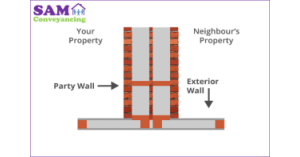
For party structures, which are any structures that physically separate different buildings, storeys, or properties owned by different people, your neighbour has to give you two months' notice.
Failing to comply with these frameworks isn't just bad manners; it's a legal blunder that can quickly escalate unnotified projects into full-scale party wall disputes. It grants affected neighbours the right to seek an immediate High Court injunction to freeze the build entirely, often forcing the non-compliant developer to foot the entire legal bill.
Why you can't afford to face a property dispute unarmed
Ultimately, understanding how the laws work transforms you from a vulnerable neighbour into an untouchable one. Relying on a builder's verbal promise or a neighbour's 'good guy' reputation during extensive neighbour building work is a financial trap. Once a foundation trench is dug and the concrete is dry, proving that their excavation caused your structural cracking becomes an incredibly difficult, expensive forensic nightmare.
Knowing your legal shields allows you to set clear boundaries before the heavy machinery arrives, ensuring that your neighbour remains strictly liable and preventing long-term property disputes over structural damage.
However, if the situation progresses and you make a formal complaint to the council, or log a dispute with a solicitor about a neighbour's building work, you are legally required to declare this when you sell your house in a TA6 Property Information Form.
The 5 legal shields you need to know and how they work
Now that you know you need a tactical playbook, it's time to suit up. UK property and environmental law actually grants you some incredibly powerful armour to protect your home from a stressful property dispute, if you know how to wield it.
- 1
The dawn-raid blocker: statutory nuisance protection
If a neighbouring building site is burying your home in dust or vibrating your walls at dawn, you aren't powerless. You are protected by Section 79 of the Environmental Protection Act 1990 against highly disruptive building work.
While standard daytime construction noise is a legal reality of development, builders do not have a free pass to work whenever they want. Most UK local authorities enforce strict working hours for heavy, noisy machinery:
- Weekdays: 8am - 6pm
- Saturdays: 8am - 1pm
- Sundays and bank holidays: Strictly prohibited
If site radios are blasting at 6:30am or dust is caking your windows, your local council's Environmental Health Department has a legal duty to investigate. If a statutory nuisance is found, they will secure a criminal Abatement Notice. And, if the builders breach this, they face hefty fines and prosecution.
- 2
Free-Surveyor defence: Party wall protections
When a neighbour plans to cut into a shared wall, insert damp-proof courses, or dig foundations within 3 to 6 meters of your property, the Party Wall etc. Act 1996 becomes your shield against boundary-related property disputes.
Property owners must serve you a formal Party Wall Notice 1 to 2 months before any neighbour building work begins.
- The 14-day rule: If you formally dissent (object) to the notice, or simply ignore it for 14 days, a legal dispute is automatically triggered.
- Who pays? By law, the building neighbour must foot the bill for a qualified Party Wall surveyor (or surveyors) to represent both parties.
The surveyor will draft a legally binding Party Wall Award. This includes a detailed Schedule of Condition, a photographic baseline of your home before works start. If construction later causes cracks or structural issues, this shield ensures you aren't left paying for their mistakes.
- 3
Airspace trespass shield: Boundary and crane protections
Builders frequently assume they can swing the jib of a giant tower crane through your airspace or erect scaffolding poles on your pathway. They cannot. Under Common Law Civil Trespass, your property rights extend to the sky above your roof and the ground beneath your feet.
Furthermore, the Access to Neighbouring Land Act 1992 is often misinterpreted by builders. This law only grants access to your land for essential preservation and maintenance of an existing structure (like fixing a roof).
There is no legal right for a developer to encroach on your land or your airspace to build a brand-new extension or development. You are well within your legal rights to refuse access entirely until they sign a formal, negotiated Access Licence, keeping minor neighbour disputes from turning into costly court battles. This often includes a substantial financial payout (licence fee) to you for the inconvenience.
- 4
Highway obstruction ultimatum: Highways and access protection
When a massive, unlit builder's skip is dropped directly outside your house and obstructs the pavement or your driveway, you have the Highways Act 1980 on your side.
The public road and pavement do not belong to the developers. To place a skip on a public highway, they must strictly adhere to local regulations:
- Permit required: They must hold a valid, active permit from the Local Highway Authority.
- Safety rules: By law, the skips must feature retro-reflective markings, be properly guarded by traffic cones, and be clearly lit at night.
If a skip lacks a permit, has no safety lighting at night, or blocks your access (such as a dropped kerb), it is an illegal obstruction. A quick report to your local council's highways department can result in immediate fines for the builder and the skip being towed away within hours.
- 5
The 20-year injunction trap: The 'Right to Light'
One of the costliest mistakes extending neighbours make is assuming that gaining council planning permission gives them an absolute right to build. It does not. Planning law and property law are entirely different entities. If a proposed double-story extension threatens to plunge your home into a permanent shadow, your best shield against potential property disputes is the Prescription Act 1832.
If the neighbour's new brickwork fails the standard BRE 45-degree assessment, meaning it mathematically and significantly reduces your indoor daylight, you can take them to the High Court. This shield is incredibly potent: a judge can issue an injunction to halt construction mid-build or, in severe cases, force the developer to tear down completed brickwork at their own expense.
Ultimately, these five shields prove that UK property and environmental law isn't just there to regulate developers, but it is actively designed to protect your everyday quality of life and resolve ongoing property disputes. You do not have to just sit back and accept structural risks, lost daylight, or endless disruption. Armed with the right statutory acts and regulations, the power is entirely in your hands to stand your ground.
Shield | Governing law | When to deploy | Key benefit |
1. Dawn-raid blocker | Section 79, Environmental Protection Act 1990 | Out-of-hours noise, excessive dust, or heavy vibrations. | Council forces site shutdown or issues fines via a criminal Abatement Notice. |
2. Free-surveyor defence | Party Wall etc. Act 1996 | Works on shared walls or deep foundation digging within 3–6m. | Neighbour must pay for your surveyor; creates a legal baseline for future damage claims. |
3. Airspace trespass lock | Common Law & Access to Neighbouring Land Act 1992 | Scaffolding erected on your land or crane jibs swinging over your roof. | You can block work entirely until they sign an Access Licence and potentially pay you a licence fee. |
4. Highway obstruction ultimatum | Highways Act 1980 | Unpermitted, unlit, or hazardous skips blocking roads, pavements, or driveways. | The Highways Authority can issue instant fines and remove the skip within hours. |
5. 20-Year injunction trap | Prescription Act 1832 | New extensions or developments that block natural light from your windows. | Completely independent of planning permission; can force a build halt or a total teardown. |
Ultimately, these five shields prove that UK property and environmental law isn't just there to regulate developers, but it is actively designed to protect your everyday quality of life. You do not have to just sit back and accept structural risks, lost daylight, or endless disruption. Armed with the right statutory acts and regulations, the power is entirely in your hands to stand your ground and successfully handle any property disputes that arise.
Expert Tip: Remember the TA6 Property Information Form
If you enter a formal legal dispute with your neighbour, which also involves instructing a solicitor or lodging official complaints with the council, you are legally required to disclose this on the TA6 Property Information Form when you eventually sell your house.
Failure to disclose an active neighbour dispute or property dispute is a breach of the Consumer Protection from Unfair Trading Regulations 2008, and it could allow your buyer to sue you for major financial compensation after moving in. In serious circumstances, unresolved, messy disputes can even devalue a property or break future sales. To mitigate this risk, always speak to your neighbour before escalating to formal authority logging.
CEO of SAM Conveyancing
What does enforcing your rights cost?
One of the biggest reasons homeowners hesitate to use their legal shields is the fear of racking up thousands of pounds in solicitor fees. In reality, most of these core protections cost you absolutely nothing out of pocket. The total cost depends entirely on the legal path you choose to resolve your property dispute.
Legal route | Who pays? | Estimated cost to you |
Party Wall dissent | The extending neighbour (by statutory law) | £0 |
Council noise/skip complaint | The taxpayer/council budget | £0 |
Access Licence Agreement | The neighbour (you can request they cover your legal fees) | £0 |
Right to Light/injunction solicitor | You (upfront, though costs can be recovered if you win) | £1,500 – £5,000+ |
Expert Tip: The cost vs reward reality
While a Right to Light injunction is the only route requiring upfront legal costs, it also carries massive leverage. Because a judge can force a developer to tear down a building, developers will almost always settle out of court. This means your upfront legal costs are frequently recovered as part of a substantial compensation payout, putting a definitive end to the property dispute.
CEO of SAM Conveyancing
Case study: The new frontier of airspace trespass
The landscape of modern property disputes is constantly shifting, and a recent case in the High Court has updated airspace rules for the modern era of commercial drone flights.
In the landmark case of MBR Acres Ltd v Curtin 2025, the High Court mapped out the modern boundaries of a homeowner's sky rights. The court reaffirmed the foundational principle that a landowner’s rights in the airspace above their property strictly extend to the height necessary for the ordinary use and enjoyment of the land and its structures.
The ruling confirmed that while normal high-altitude flights are permitted, if a neighbouring developer or surveyor launches a drone to film your property, map your boundary, or inspect your roof without consent, and they do it at a low height or hover constantly over your garden in a way that directly interferes with your ordinary use and enjoyment of the property, it constitutes a civil trespass. The law treats it exactly the same as a builder physically stepping into your garden, giving you the clear legal right to step in before severe neighbour disputes escalate.
How long does it take to deal with nuisance building work?
When an aggressive build next door triggers a stressful property dispute, every day can feel like a lifetime, but deploying your legal shields doesn't mean waiting months. Local authorities and courts can act with blistering speed when the right pressure is applied.
The realistic timelines for deploying your defences include:
- Halting council nuisance (24 to 48 hours): If you can prove developers are working outside of permitted hours, local Environmental Health teams have the power to inspect, issue a stop notice, and halt unauthorised work almost instantly.
- Securing a Party Wall surveyor (2 to 4 weeks): If your neighbour completely failed to serve a statutory Party Wall Notice, an emergency High Court injunction to stop their builders can be granted within 48 hours. While resolving the deeper, underlying property dispute will take a few weeks, the physical build will stop immediately.
Expert Tip: Speed up your evidence gathering
Don't waste your time filming hours of shaky, silent video footage. Instead, download a calibrated decibel (dB) meter app on your mobile device. Snap time-stamped screenshots showing the noise level climbing past 70dB before 8am, and email this data directly to your local council's out-of-hours noise team. Clear, data-backed evidence triggers an immediate, high-priority investigation, while a vague complaint gets buried.
CEO of SAM Conveyancing
Taking control: how to deploy your legal shields
When neighbouring construction begins to compromise your property or your peace of mind, acting methodically ensures you maintain maximum legal leverage. Following this direct sequence allows you to regain control of the situation swiftly and avoid disputes over protected property.
You need to:
- Get in contact with your neighbour: As a starting point, it's always best to politely ask your neighbour to confine high-impact, noisy work to specific blocks of time during the week. You can also flag other issues that they may not be aware of that are disturbing the enjoyment of your home.
- Start a comprehensive disruption diary: If informal conversations fail to resolve the issue, start by gathering evidence of the nuisances and how they are affecting you. Document with time-stamped photos of dust, unlit skips, or decibel recordings. Make sure you log exact dates, times, and specific details of the disruption.
- Trigger official enforcement channels: With your evidence diary finalised, deploy the appropriate regulatory shield to halt the disruption. Submit your noise and dust logs to the council’s Environmental Health team, contact the Highways department regarding unpermitted road obstructions, or formally instruct a property litigation solicitor to issue an urgent legal warning for active Party Wall or airspace trespass breaches before it turns into an all-out property dispute.
Ready to reclaim your peace of mind?
From complex property disputes and party wall conflicts to structural property damage caused by neighbour building work, our experienced property litigation team steps in to handle the legal proceedings to protect your home and restore your peace of mind.
You can secure a free initial consultation to map out your next steps.
Frequently asked questions about property disputes

Andrew Boast FMAAT is a qualified accountant, conveyancing specialist and author with over 25 years of experience in the UK property sector. Since beginning his career in 2000 within established SRA and CLC-regulated conveyancing solicitor firms, Andrew has overseen the legal journeys of more than 75,000 clients.
He is the self-published author of the first-time buyer guide: How to Buy a House Without Killing Anyone, and a frequent contributor to mainstream UK media on legislative updates, property law, first-time buyer guides, conveyancing best practices, and stamp duty changes. Andrew specialises in resolving complex title issues, property conflict disputes, and property tax options, streamlining the enquiry process to reduce transaction times and maintaining a client-friendly focus.