The Contract of Sale in Conveyancing Explained in Simple English

The Contract of Sale is the legally binding document that binds the buyer and seller to complete the transfer of land or property in England and Wales. The drafting of the contract happens right at the outset of the conveyancing process; however, it only ever becomes legally binding once your solicitor exchanges contracts.
The terms of the contract are standard; however, errors or omissions can delay finalisation of the process. In this article, we explain how the contract is drafted, common mistakes, how to negotiate the terms, and the process for making the contract binding.
What is the Contract of Sale in Conveyancing?
The contract of sale is the central legal document that outlines the terms and conditions of a property transaction in England and Wales. Until the contract is exchanged, the property is noted as Sold Subject to Contract by the estate agent. This means that the seller and the buyer have agreed in principle to sell at a price, but neither is legally or financially bound to the transaction until the contract is exchanged; hence, subject to contract.
With no commitment to buy after an offer, and your only financial implication being your own legal and survey costs, both the buyer and seller are acutely focused on getting the transaction exchanged as quickly as possible to make each other legally bound.
The Standard Conditions of Sale (SCS) Explained
To ensure consistency and fairness across the residential market in England and Wales, the vast majority of contracts incorporate the Standard Conditions of Sale. Currently, the Fifth Edition – 2018 Revision is the industry standard. These conditions are a set of "ready-made" Terms & Conditions maintained by the Law Society that govern common issues such as:
- The payment and holding of the deposit.
- The seller's duty is to provide "vacant possession" upon completion.
- The risk/implications and remedies for breaching the contract between the exchange and completion.
By using the SCS, solicitors can focus on the "Special Conditions" specific to the property rather than renegotiating basic legal principles for every transaction.
What are the key clauses in the Contract?
The following are the key parts of the standard contract, but shouldn't be read in isolation. You should read the complete contract before signing it.
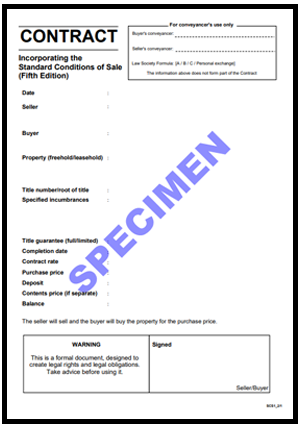
Element | Detail |
Particulars | Names of the Seller and Buyer, the property address, and the Title Number from HM Land Registry. If selling more than one title, all titles should be included. |
Property Type | State whether the property is freehold or leasehold. If you're buying a share of freehold, it'll state leasehold, but also include the percentage share of the freehold you are buying. |
Title Number/Root of Title |
|
Specified incumbrances | This is left blank on the front page, but is defined in full in Section 3 of the Standard Conditions. |
Title guarantee (full/limited) |
|
Completion Date | This is left blank until the chain agrees to the exchange of contracts. |
Contract Rate | This is always the Bank of England Base Rate, which is currently 3.75% . |
Purchase Price | The agreed price to buy the Title Numbers includes all the property within the demise and is marked as included in the TA10 Fittings and Contents Form. |
Exchange Deposit | Contractually, this is 10% of the purchase price. |
Contents Price | The total cost of Chattels is not included in the TA10 Form for the property. |
Standard Conditions | There is a list of standard conditions both the seller and buyer must follow; these are some of the standout ones.
|
Example Contract of Sale 5th Edition
Expert Tip - Don't worry about hand-amended contracts
The contract of sale is often hand amended during the conveyancing process, so do not worry if your name is spelt incorrectly. Simply hand amend the error, sign the contract and send it back to your solicitor.
You can ask your solicitor to amend it; however, as the seller's solicitor has drafted it, it'll either take over a week to get amended, or they'll refuse to amend and tell you to hand amend the error.
CEO of SAM Conveyancing
Do CQS firms always use the standard contract?
The Conveyancing Quality Scheme (CQS) is designed to ensure that all member firms follow the Law Society Conveyancing Protocol. This protocol explicitly directs solicitors to use the Law Society’s own standard forms and conditions to ensure transparency and efficiency.
For residential sales, CQS firms are expected to use the SCS (5th Edition – 2018 Revision). Deviating from these without a specific legal reason can be seen as a breach of the protocol’s goal to "reduce the time taken" and "minimise the potential for disputes. The primary benefit for a CQS solicitor is that they know exactly what is in the small print of another CQS solicitor’s contract, allowing them to focus only on the special conditions and enquiries.
Exclusions to the use
Even for a CQS-accredited firm, there are specific circumstances where the SCS may not be used, or may be heavily modified:
- New Build Properties: Developers often have their own bespoke contracts. While these may incorporate some elements of the SCS, they often include extensive "developer-friendly" clauses regarding construction timelines and snagging that override standard conditions.
- Auctions: Property auctions often use the Common Auction Conditions (CAC). While similar in spirit to the SCS, they are tailored for the immediate "hammer-fall" exchange process. I am Sold use their own contract that sits alongside the Standard Contract.
- Commercial Property: If a CQS firm is handling a mixed-use or commercial unit, they will switch to the Standard Commercial Property Conditions (SCPC).
When is the contract legally binding?
Exchange is the physical or telephonic process by which the two solicitors or conveyancing firms confirm that they hold identical signed contracts and have confirmation from their clients to exchange. At this precise moment:
- The completion date is finalised and written into the contract.
- The buyer pays a deposit (usually 10% of the purchase price) to the seller’s solicitor.
What Happens if a Breach of Contract Occurs?
If either party fails to complete on the agreed date, they are in breach of contract. The non-defaulting party’s solicitor will typically serve a "Notice to Complete," which usually gives the defaulting party ten working days to finalise the transaction. If they still fail to complete:
- If the Buyer defaults, the seller can rescind the contract, retain the 10% deposit, and resell the property.
- If the Seller defaults, the buyer is entitled to the return of their deposit with interest and may claim for losses incurred due to the delay.
What happens after you sign your contract of sale?
Once your solicitor has finalised the legal enquiries, they will begin preparing to exchange contracts. This includes preparing the Report on Title, the signing documents, securing the completion date, and more.
Your Next Step in the Conveyancing Process:
Preparing for Exchange of Contracts
Our conveyancing process area includes:
- online checklists
- videos
- free downloads
- useful tips
It is completely free to use - from start to finish - and saves your progress along the way.
Bonus: Get a FREE book: House to Buy a House without Killing Anyone (Value £9.99).
Frequently Asked Questions

Andrew Boast FMAAT is a qualified accountant, conveyancing specialist and author with over 25 years of experience in the UK property sector. Since beginning his career in 2000 within established SRA and CLC-regulated conveyancing solicitor firms, Andrew has overseen the legal journeys of more than 75,000 clients.
He is the self-published author of the first-time buyer guide: How to Buy a House Without Killing Anyone, and a frequent contributor to mainstream UK media on legislative updates, property law, first-time buyer guides, conveyancing best practices, and stamp duty changes. Andrew specialises in resolving complex title issues, property conflict disputes, and property tax options, streamlining the enquiry process to reduce transaction times and maintaining a client-friendly focus.

Amanda Ambler is a highly accomplished conveyancing specialist with over 15 years of dedicated experience across residential property law, legal compliance, and practice management. Having held senior roles, including Head of Legal Practice and Head of Conveyancing at established UK law firms, Amanda possesses a profound, hands-on understanding of the technical intricacies of the property market.
As the designated Legal Content Reviewer for SAM Conveyancing, Amanda ensures that every guide, legal update, and resource published meets the absolute highest standards of accuracy, regulatory compliance, and factual integrity. Her rigorous review process guarantees that complex property legislation and industry processes are communicated clearly, transparently, and safely for home buyers and sellers alike.

Exchanging Contracts: A Guide to Legally Binding Your Move