Property Flood Risk Reports Explained

A Flood Risk Report is a desk-study assessment of how likely it is that the property you intend to purchase will suffer from flooding at some point in the future, based on historical data and advanced predictive modelling. The report gathers information from various official agencies and confirms if you will face any challenges when looking to insure your property.
The report is normally purchased by the buyer as part of the conveyancing process to inform them of the risks that flooding could have on their new home. Unlike the local authority and water and drainage searches, this is not mandatory unless explicitly flagged by your mortgage lender.
- If you want to secure home insurance at standard terms, you will need to know if your property has a high flood risk.
- A flood risk search is based on data from leading authorities, including the Environment Agency, Natural Resources Wales, and JBA Risk Management.
- The Flood Risk Report costs £64 INC VAT and its turnaround time is just 2 working hours.
Get a Flood Risk Report
Download a Flood Risk Report for £64 INC VAT | Report emailed within 2 working hours | Report includes:
- River, sea, surface & ground water.
- Historic flooding.
- Flood storage and dam breaks.
- Home insurance issues.
Should I get a flood report?
Mortgage lenders do not always automatically require you to book a standalone flood risk report—it is not always among their stipulated property searches—but it is highly recommended. You will absolutely need to inform your building insurers if the property has flooded previously or is located in a high-risk flood area.
Building Insurance Flood Risk
When applying for building insurance, you must provide accurate information about the property's flood risk. If you fail to declare historical flooding or a known high-risk status (even accidentally), and your home is subsequently flooded, your policy will likely be invalidated. This leaves you completely uninsured and personally liable for repair costs that can easily reach tens of thousands of pounds.
Furthermore, because maintaining comprehensive building insurance is a strict legal condition of almost all residential mortgages, an invalidated policy could inadvertently place you in direct breach of your mortgage terms.
How the report protects you:
- Accurate Disclosure: The report provides the exact JBA Floodability Rating that over 85% of the insurance market uses, removing all guesswork from your application.
- The Flood Re Scheme: If your prospective home is flagged as high risk, the report will indicate if it is eligible for Flood Re. This is a joint initiative between the UK Government and the insurance industry designed to ensure affordable home insurance remains available for households in high-risk flood areas.
What is in a Flood Risk Report?
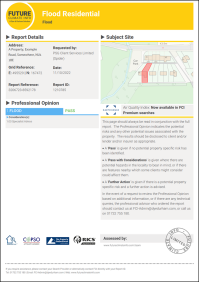
A comprehensive report assesses multiple sources of potential flooding to give your property an overarching Professional Opinion (graded as a Pass, Pass with Considerations, or Further Action).
Section | What is included |
|---|---|
| River and Sea Flood Risk | Data provided by the Environment Agency indicates the risk of flooding to the property and its building footprint from nearby rivers or the sea. |
| Surface Water Flood Risk | Assesses the risk of surface water flooding, which occurs when heavy rainfall overwhelms the local drainage capacity and rainwater lies on or flows over the ground instead of draining away. |
| Groundwater Flooding | Using JBA Risk Management data, this checks the annual chance of peak groundwater levels reaching within 5 metres of the ground surface, potentially causing flooding to subsurface assets. |
| Surface Water Features | Checks Ordnance Survey Maps to see if the property is located within 250 metres of a body of surface water, such as a stream, river, canal, reservoir, lake, or pond. |
| Insurance Considerations | Provides a JBA Floodability Rating (colour-coded from Green/No Colour up to Black 2) to indicate the insurance market's probable interpretation of flood risk at the property. Higher ratings identify if a property is a potential candidate for the Flood Re insurance scheme, designed to help households in flood-risk areas find affordable home insurance. |
| Historic Flooding | Data provided by the Environment Agency indicates if the property is in, or within 250 metres of, an area that has flooded in the past (including groundwater floods). |
| Flood Storage | Data provided by the Environment Agency indicates if the property is located within 25 metres of a Flood Storage Area (land specifically designed and operated to store flood water). |
| Dam Break | Identifies areas most likely to suffer damage following the sudden and catastrophic failure of a large reservoir embankment or dam (representing a worst-case scenario using advanced modelling techniques). |
How much does a flood risk report cost?
Flood Risk Reports cost £64 INC VAT and normally takes just 2 working hours to be emailed directly to you.
Get a Flood Risk Report
Download a Flood Risk Report for £64 INC VAT | Report emailed within 2 working hours | Report includes:
- River, sea, surface & ground water.
- Historic flooding.
- Flood storage and dam breaks.
- Home insurance issues.
Does a surveyor attend the property?
No. The Flood Risk Report is a desktop assessment, and no one attends the property to conduct a physical inspection of the flooding risk. Instead, report providers use highly accurate historical data and high-resolution flood hazard maps to determine the risk level.
If the property is in a high flood risk area, you should instruct a RICS Surveyor to inspect the property and confirm if there are any signs of flood damage.
Frequently Asked Questions

Andrew Boast FMAAT is a qualified accountant, conveyancing specialist and author with over 25 years of experience in the UK property sector. Since beginning his career in 2000 within established SRA and CLC-regulated conveyancing solicitor firms, Andrew has overseen the legal journeys of more than 75,000 clients.
He is the self-published author of the first-time buyer guide: How to Buy a House Without Killing Anyone, and a frequent contributor to mainstream UK media on legislative updates, property law, first-time buyer guides, conveyancing best practices, and stamp duty changes. Andrew specialises in resolving complex title issues, property conflict disputes, and property tax options, streamlining the enquiry process to reduce transaction times and maintaining a client-friendly focus.

Amanda Ambler is a highly accomplished conveyancing specialist with over 15 years of dedicated experience across residential property law, legal compliance, and practice management. Having held senior roles, including Head of Legal Practice and Head of Conveyancing at established UK law firms, Amanda possesses a profound, hands-on understanding of the technical intricacies of the property market.
As the designated Legal Content Reviewer for SAM Conveyancing, Amanda ensures that every guide, legal update, and resource published meets the absolute highest standards of accuracy, regulatory compliance, and factual integrity. Her rigorous review process guarantees that complex property legislation and industry processes are communicated clearly, transparently, and safely for home buyers and sellers alike.