Understand the Water and Drainage CON29DW Search

When purchasing a residential property in England or Wales, what lies beneath the ground is just as critical as the brickwork above. A drainage and water search, specifically the official CON29DW report, is a fundamental component of the conveyancing process. It ensures you are fully aware of how a property interacts with the local water infrastructure before you finalise your contract.
Surface water flooding has become a serious issue in recent times in England and Wales, and so good access to drainage is highly important. If you're buying a house, it is important to check how this will affect your property. Your conveyancing solicitor will read your water and drainage search and advise you if any matters of concern are flagged up.
What is a water and drainage search?
Developed by the Law Society alongside the water industry in 2002, the CON29DW is a standardised property search compiled directly from statutory water authority records. Unlike generic "regulated" or personal drainage searches, a genuine CON29DW utilises direct water company billing and asset data, offering comprehensive legal indemnities (often up to £10 million) to protect buyers and legal professionals.
The report uses precise mapping and factual data to provide definitive answers to 23 standard questions. It focuses entirely on public infrastructure, mapping out the precise layout of public water mains, lateral drains, and public sewers relative to the property's boundary.
Are
Property
Searches?
By Andrew Boast, CEO of SAM Conveyancing
Why do buyers need a water search?
If you are buying with a mortgage, then your solicitor has an obligation to carry out the Water and Drainage Search. The guidance for this is within the Mortgage Lenders' Handbook.
5.4.1:...you must ensure that all usual and necessary searches and enquiries have been carried out.
Source: UK Finance: Mortgage Lenders' Handbook for Conveyancers
You cannot buy a house with a mortgage without this search because your solicitor needs the information within the report to satisfy this requirement of the lender. If you are a cash buyer, you can proceed without the search at your own risk.
When do you order the water search?
During the conveyancing process, you normally order the water search along with the local authority and environmental searches once three contracts have come in from the seller's solicitor. This is normally around 1 to 2 weeks after the sales memorandum has been issued by the estate agent.
What is included within the Con29DW Report?
The standard Law Society-approved CON29DW report is split across four core technical sections. The report includes 25 questions (including critical sub-enquiries) that cover critical infrastructure details. The complete list of questions answered by the water authority records includes:
What is the Difference Between an Official and Regulated Water Search?
Your conveyancer will obtain either an Official CON29DW Search or a Regulated (Personal) Water Search. The differences between the two are as follows:
Official CON29DW search | Regulated (personal) water search |
|
|
Expert Tip: Not all lenders allow regulated water searches
Also known as "personal searches", not all mortgage lenders will allow you to have a regulated search. You can use the SAM Conveyancing lender checker below to confirm if your lender allows for regulated searches:
Select your lender from the dropdown and check whether they accept regulated searches or require official searches from the Local and Water Authorities.


CEO of SAM Conveyancing
What is the cost of a CON29DW Report?
The cost varies between the water authorities in England & Wales. The most expensive is Leep Utilities, and the cheapest is Northumbrian Water. Here's the complete list of water boards/authorities, their costs, and turnaround times.
Water Board / Authority | Official CON29DW Fee (Inc. VAT) | Typical Turnaround Time |
Leep Utilities | £84.00 (£70.00 Ex VAT) | 1–3 working days |
Thames Water | £83.40 (£69.50 Ex VAT) | 1–3 working days |
Anglian Water (Geodesys) | £78.00 (£65.00 Ex VAT) | 1–2 working days |
Severn Trent Water | £76.20 (£63.50 Ex VAT) | 1 working day |
Southern Water | £69.78 (£58.15 Ex VAT) | 1–3 working days |
Wessex Water | £68.68 (£57.23 Ex VAT) | 1–3 working days |
South West Water | £68.29 (£56.91 Ex VAT) | 1–3 working days |
Yorkshire Water (SafeMove) | £66.00 (£55.00 Ex VAT) | 1–3 working days |
United Utilities | £63.90 (£53.25 Ex VAT) | 1–3 working days |
Welsh Water (Dŵr Cymru) | £58.80 (£49.00 Ex VAT) | 1–3 working days |
Northumbrian Water (inc. Essex & Suffolk Water) | £56.80 (£47.33 Ex VAT) | 1–3 working days |
What are the different types of water authority enquiries?
When a conveyancing solicitor receives the results of a CON29DW search, they cross-reference the data against the Land Registry title maps and the physical layout of the property. If any anomalies or asset markers appear, they will raise specific pre-contract enquiries with the seller's solicitor.
The top 5 legal enquiries raised directly as a result of a water and drainage search include:
The build-over agreement enquiry (Questions 2.4 & 2.7)
If the CON29DW map shows a public sewer or lateral drain running within the boundary, and a physical extension, garage, or conservatory has been built over or within 3 metres of that line, a specific enquiry is triggered.
Enquiry:"The water search indicates a public sewer passes within the property boundary. Please provide a copy of the formal Build-Over Agreement or a retrospective 'Comfort Letter' issued by the water authority for the extension".
The Build-over Agreement enquiry is a high-risk for a home buyer. Without this, the water authority holds statutory powers to excavate the pipe for repairs, which could mean dismantling the extension with no obligation to cover rebuilding costs.
The internal sewer flooding mitigation enquiry (question 2.8)
If Question 2.8 flags that the building is on the statutory water authority's risk register for internal sewer flooding, it is treated as a severe priority item.
Enquiry:"The CON29DW report confirms the property is at risk of internal sewer flooding. Please provide the dates of all historical flooding events, details of any compensation claims, and proof of any mitigation systems (such as non-return valves) installed by the seller or the utility company".
This is a critical risk as it could make the property uninsurable. A history of sewer flooding can make it impossible for the buyer to secure standard structural home insurance, which automatically breaches the mortgage lender's criteria.
The Private Surface Water Soakaway Enquiry (Question 2.2)
When the search reveals that surface water (rainwater run-off) does not drain into a public sewer system, it means the property relies on independent infrastructure.
Enquiry:"The search confirms surface water does not discharge to a public sewer. Please confirm if the property drains to a private soakaway or an adjacent watercourse. If a soakaway, please confirm its exact physical location and its maintenance history".
Failed or blocked private soakaways cause water to pool near foundations, leading to long-term structural movement, known as subsidence. If a soakaway is located on a neighbour's land, a formal legal easement must be verified.
The Section 104 Adoption Agreement Enquiry (Questions 2.6 & 3.3)
This enquiry is routinely raised for new builds or homes located on modern housing developments where the local infrastructure has not yet been formally handed over to public ownership.
Enquiry:"As the estate sewers and water mains are currently unadopted, please provide a copy of the Section 104 Agreement (or Section 98 for water supply) along with proof that the developer's financial maintenance bond remains valid".
If the developer goes bust before the systems are adopted, the local water board will refuse to take ownership until the pipes are brought up to standard, leaving the homeowners with shared repair bills that can run into tens of thousands of pounds.
The Cesspit Legal Enquiry
When a water and drainage search (CON29DW) or the seller’s TA6 Property Information Form reveals that a property is not connected to the public sewerage network, it triggers deep technical investigations. If the property relies on a cesspit (a completely sealed underground holding tank with no drainage outlet, distinct from a septic tank or treatment plant), a specific off-mains drainage enquiry must be raised.
Enquiry:"The searches confirm the property utilises a cesspit located at [Location] for foul drainage. Please provide full maintenance records for the past 3 years, confirm the date it was last emptied, provide a copy of the original Building Regulations completion certificate for its installation, and confirm whether any notices or complaints have been issued by the Environment Agency or Local Authority regarding its operation".
There are huge risks around a cesspit; do you have access to empty it, is the tank physically intact, and do you have Building Regulations Sign-off? Add to this the financial burden of having to empty it, this is a top enquiry to get answered.
What other enquiries could get raised?
- Do the records inspected indicate that foul water from the property drains to a public sewer?
- Do the records inspected indicate that surface water from the property drains to a public sewer?
- Does the Public Sewer Map indicate any public sewer, disposal main or lateral drain within the boundaries of the property?
- Does the Public Sewer Map indicate any public sewer within 30.48 metres (100 feet) of any buildings within the property?
- Does the Public Sewer Map indicate that sewers or lateral drains serving or which are proposed to serve the property, the subject of an existing adoption agreement or an application for such an agreement?
- How can the drinking water quality for the area be checked?
- Do the records inspected indicate the property is connected to the main water supply?
- Are there any water mains, resource mains or discharge pipes within the boundaries of the property?
- Who are the sewerage undertakers for this area?
- Who are the water undertakers for the area?
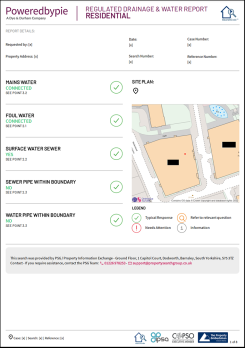
An example
Water &
Drainage Search
Frequently Asked Questions About the Water and Drainage CON29DW Search

Andrew Boast FMAAT is a qualified accountant, conveyancing specialist and author with over 25 years of experience in the UK property sector. Since beginning his career in 2000 within established SRA and CLC-regulated conveyancing solicitor firms, Andrew has overseen the legal journeys of more than 75,000 clients.
He is the self-published author of the first-time buyer guide: How to Buy a House Without Killing Anyone, and a frequent contributor to mainstream UK media on legislative updates, property law, first-time buyer guides, conveyancing best practices, and stamp duty changes. Andrew specialises in resolving complex title issues, property conflict disputes, and property tax options, streamlining the enquiry process to reduce transaction times and maintaining a client-friendly focus.

Amanda Ambler is a highly accomplished conveyancing specialist with over 15 years of dedicated experience across residential property law, legal compliance, and practice management. Having held senior roles, including Head of Legal Practice and Head of Conveyancing at established UK law firms, Amanda possesses a profound, hands-on understanding of the technical intricacies of the property market.
As the designated Legal Content Reviewer for SAM Conveyancing, Amanda ensures that every guide, legal update, and resource published meets the absolute highest standards of accuracy, regulatory compliance, and factual integrity. Her rigorous review process guarantees that complex property legislation and industry processes are communicated clearly, transparently, and safely for home buyers and sellers alike.