What is a deed of trust?
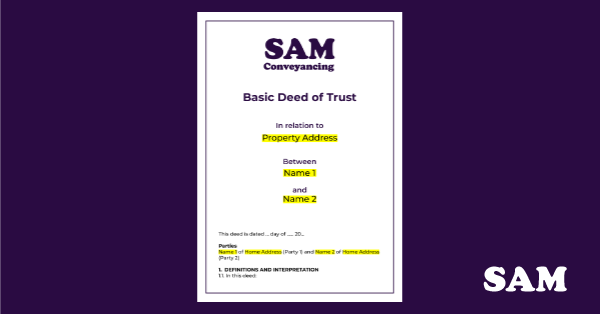
Trust deeds are documents for joint owners which declare your percentage of ownership, also known as your beneficial interest shares. Ours are drafted by our expert solicitors and executed as a deed, making them legally binding.
A deed of trust can also outline your intentions for the property, such as how you will split expenses, how you will divide any income from the property if it is rented, and when and how you will handle a sale, or breakdown of the relationship between the joint owners.
1. Place your order

2. Revise/Sign your deed

3. Return for certification

What do I get from a Deed of Trust?
Protect your interests, intentions, and financial well-being in a transparent, legally enforceable document, executed as a deed.
-
Protect what you invested in the property.
-
Agree on the terms of how to sell if one person doesn't want to.
-
Legally bind the owners to the terms and conditions outlined in the deed.
-
Save legal fees if you have to go to court to force a sale.
-
Avoid future arguments over original property ownership intentions.
-
Easy submission to HMRC is required for income tax evidence.
Who needs a deed?
I'm buying jointly
If the investment and responsibility is going to be anything other than 50/50.
I'm an existing owner
If you need to change the split of shares with an existing joint owner, or assign some shares to a new beneficiary.
I'm gifting a deposit
If you want to protect that deposit. For example, if you want to get it back when the property is sold, or you want to ensure that your child gets your full gift back before any other equity is split in the event that their relationship with their joint owner breaks down.
I'm submitting Form 17 for HMRC
If you are married or in a civil partnership, to register unequal ownership for tax efficiency.
I'm separating from my spouse
If you need to assign all your shares to your ex, but remain on the legal title for mortgage purposes.
I'm investing in a property
If you are investing a specific share into a property, and want to see your investment returned either as a fixed amount plus interest, or as a share of sale proceeds, with provisions for how and when you can get your investment back.
I'm moving in with the legal owner
You can make sure your contributions are clearly defined as earning you a beneficial interest in the property, or, if you're not contributing to a mortgage, etc., you can declare no beneficial interest, to protect your partner's ownership.
Why do I need a deed?
Different deeds serve different purposes, such as: protecting parents who are helping their children to buy their first home, ensuring unmarried couples have a fair exit strategy in case of a break-up after buying a home together, or providing tax-efficient ownership for married couples and civil partners.
The deed is professionally drafted and executed in front of witnesses, so it can be relied upon in the event of a falling out or disagreement, enforced in court, submitted to HMRC, or used to register a restriction on the title at the Land Registry.
A verbal agreement or simple declaration of trust is not sufficient to protect your interests. Once signed, dated, and returned, our solicitor certifies a digital copy, which can be used immediately.

Deed of Trust
Basic Deeds of Trust to protect your interests, including deposit, income and outgoings, and what you will do if you fall out or one of you wants to sell.

Call or email for a quote on 0333 344 3234 (local call charges apply) / help@samconveyancing.co.uk, or Ask a Free Online Question.
How does our deed service work?
Your deed will be drafted to suit your needs, and you'll get one free revision. Once finalised, you print and date your deed with witnesses, who also sign the document, and then return it to the solicitor for certification. This adds an extra layer of protection against any potential dispute over the date of execution. They return a digitally certified copy, ready for immediate use, and mail back your original deed.
-
1
Please speak to a member of our deed team to discuss your requirements
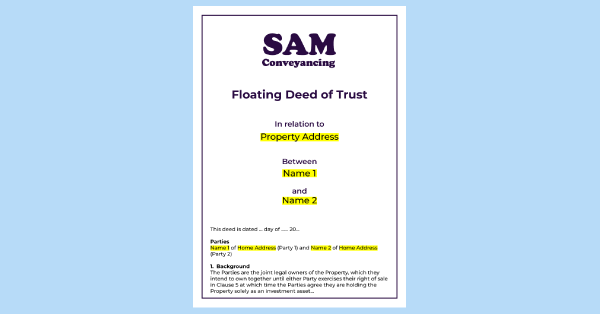
If you know what deed you require, skip this step. If you're not sure which deed is best for your needs, whether to include a floating formula, or if you want to add any bespoke provisions, then our in-house, specialist deed team in Berkshire is on hand to talk you through your options, free of charge.
You can call us on 0333 344 3234 (local call charges apply) or ask a question, and we'll call you back.
-
2
Complete our easy instruction form and make a secure online payment
If you know which deed you want, you can instruct us online instantly. If a member of our team has helped you choose, they'll send you a link to the correct form. You'll fill in your details, upload your proof of ID, proof of address, and pay our fixed fee. Our panel solicitor begins drafting your document.
-
3
Receive your first draft
Our solicitor will send you the finished draft within 1-2 working days(i). Most clients accept this draft as final, but you may make one free revision at this stage, if, for example, you realise that there was a spelling error in your original instruction.
-
4
Sign and execute your deed
To execute the document as a deed, both parties and their witnesses must sign and date the deed in wet ink. You will then mail it back to our solicitor for certification.
-
5
Receive your certified copy
Our solicitor will send you a digitally certified copy by email, ready to forward straight on to your lender, your conveyancing solicitor, the Land Registry, or to HMRC as required. Your original document will be returned to you by post.
Need your deed quickly? We can often arrange expedited document drafting for an additional fee. Contact us to discuss your urgent requirements.
At SAM, we understand you may require a deed at short notice, and offer your first draft within two working days of instruction for your convenience.
We specialise in providing Deeds and have extensive experience in a wide range of transactions.
Our solicitors are experts in explaining complex legal matters in plain English, ensuring you fully understand your rights and responsibilities. Contact us today for a fast and convenient online consultation.
Free initial advice on how our deeds can work for you
Arrange a free consultation with one of our experienced conveyancing executives if you are:
- Severing joint tenancy to register as tenants in common, or vice versa.
- Buying with your unmarried partner, to protect your shares in case the relationship breaks down.
- Married or civil partners let a property, and one of you is in a lower tax bracket.
- Buying with friends or family, to protect shares based on initial and ongoing contributions from each party.
- Going to invest money in unequal shares, improvements, or renovations on the property.
- Buying a property with a mortgage, where one or more borrower(s) will not be a legal proprietor.
- Unable to buy the other owner out and want to surrender your share.

Latest Deed of Trust Tips & Guides